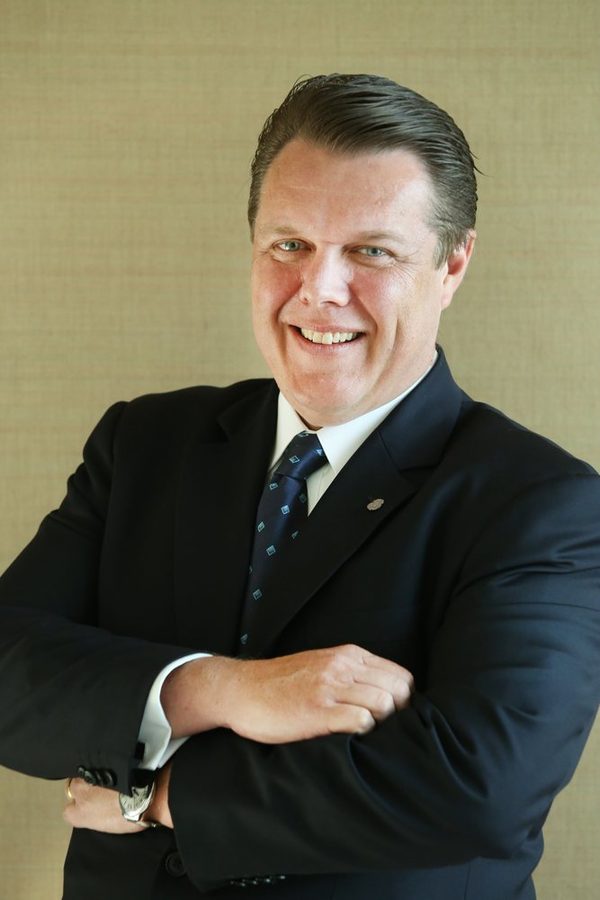
When I spoke with Krister Svensson, he was general manager of The St. Regis Bangkok. He has since become General Manager of W Melbourne and Multi Property Vice President, Luxury Hotels Australia, at Marriott International. In The Luxury of Attention he is the hotelier who shows what knowing your guest looks like at the scale of a global company, and he got there by starting at the bottom.
Svensson grew up outside Stockholm until he was nine, when his father took a post with Scandinavian Airlines in Bangkok and the family moved to Thailand. The general manager of the Hyatt where they lived, Brian Deeson, showed the boy the inner workings of a hotel and taught him that leadership means respecting every colleague every day. His mother’s love of cooking is why he entered the business through food and beverage, and his first job was as a steward in a Stockholm restaurant.
“I learned to appreciate that every job was important and valued, no matter how small it may seem.” Krister Svensson, then general manager of The St. Regis Bangkok
In Chapter 2 that start sits beside Ayman Gharib’s, who began washing dishes and peeling onions in Lebanon. Both men describe the same lesson: you cannot lead roles you have never understood from inside. Svensson’s first leadership role came at the Hyatt Regency in Dubai, running a fine dining restaurant with twenty staff from around the world.
The idea he carries in Chapter 9 is the guest profile run across an entire company. Under Marriott International, he told me, the likes, dislikes and preferences of guests are tracked across the whole portfolio of 6,000 hotels. An email before arrival captures how the hotel can best serve the guest, and the stay itself adds more. The scale is impressive on the page. The operating implication interests me more: a guest who stayed at a Marriott property in Singapore three years ago and arrives in Bangkok should, if the system is run well, find the same pillow, the same dietary note and the same snack in the room. The system lets a global brand behave locally like a property that has known the guest for years. The same conversation produced a forecast that came true. His hotel put a butler service on WhatsApp because guests were more comfortable texting than calling, and that choice became the standard I describe in The Digital Discipline.
His earlier profile is full of practical management. He holds a monthly afternoon tea with fifteen to twenty colleagues to hear what is working and what is not, and he is direct with graduates: begin at the bottom, because the staff will know more than you. The practice I would pass on first is this one.
“For instance, I hold a breakfast with overnight staff so that we openly and graciously acknowledge their contribution to taking care of the hotel while the rest of us are sleeping.” Krister Svensson, in A Wealth of Insight (2017)
The night team is the clearest case of an invisible role, and a general manager who feeds them breakfast has shown the whole hotel which jobs he counts.
In the book, Krister Svensson appears in Chapter 2, The Apprenticeship, where his start as a steward sits alongside Ayman Gharib’s start washing dishes in Lebanon; in Chapter 9, Knowing Your Guest, where his account of Marriott’s preference tracking is the most ambitious example of the practice I document; and in Chapter 14, The Future of Luxury and Craft, where his WhatsApp butler is one of the forecasts from our conversations that has since come true. Krister’s full profile, in his own words, runs 10 pages in A Wealth of Insight: The World’s Best Luxury Hoteliers (2017).
Where Krister is now
Krister Svensson is General Manager, W Melbourne, and Multi Property Vice President, Luxury Hotels Australia (Marriott International). (source, 2024)
Checked 13 November 2026. Corrections are welcome at press@theluxuryofattention.com.
The full profile, in Krister Svensson's own words
This is the complete profile of Krister Svensson as published in A Wealth of Insight: The World's Best Luxury Hoteliers on Leadership, Management, and the Future of 5-Star Hospitality, reproduced word for word. Titles and positions are as they stood at the time of the interview.
Growing Up
I grew up in a small town just outside of Stockholm, Sweden. When I was nine, my family moved to Thailand, as my father had accepted a leadership role for Scandinavian Airlines based in Bangkok. My brothers and I went to the International School of Bangkok for several years, so I grew up with a lot of different cultures and backgrounds, appreciating and respecting difference. And because my father worked for SAS, we were able to travel the world at a young age. I was enamored with the lifestyle. My mother, too, made a lasting impression on me with her love for cooking, and it’s the reason I entered the hospitality industry through the food and beverage side.
Learning the Ropes
My first job in hospitality was as a steward in a restaurant in Stockholm. Essentially, I worked to maintain a high level of cleanliness in the dining area and in the kitchen. I learned early on that starting from the bottom was incredibly important to understanding roles you would otherwise be oblivious to later on. I learned to appreciate that every job was important and valued, no matter how small it may seem.
Embracing Difference
I joined the Hyatt Regency in Dubai in 1989 as a sales executive, long before the glitz and glamor of today, and later on landed my first leadership position as restaurant manager for Hugos, a fine-dining establishment at the same property. I was in charge of twenty staff that hailed from all over the world. Because of my upbringing around different cultures, religions and nationalities, I was able to quickly adapt to and unify the team towards a common understanding of our shared vision and goals. Regardless of our differences, we were human, and we needed to treat each other with respect, dignity, and humility.
Not a One-man Show
Leading a five-star hotel, or any hotel, is never a oneman show. You need to build a team you can trust, and based on that trust, you can delegate and empower. While it’s important to celebrate the achievements of individuals along the way, it is equally important to celebrate the achievements of the team as a whole. Recognition and empowerment are motivators for success, and the more responsibility and authority a colleague feels about his or her role, the more invested they will become in the success of their duties.
An Early Mentor
While we lived at the Hyatt in Bangkok, Brian Deeson, the general manager at the time, became a close friend of my father. When I was young, he gave me the opportunity to learn more about the industry. Thirty-five years later, I climbed the ladder to become general manager of a luxury hotel. In no small part was I inspired and motivated by Brian. He exposed me to the inner-workings of a property, and taught me that leadership is about respecting and appreciating each and every colleague every day.
Different Routes, Same Path
When hiring, I look for a degree in hospitality, but by no means is this the only path to managerial responsibilities. I am a firm believer in working your way up in the industry, whether starting at the front-of-thehouse or the-back-of-the-house, in the kitchen or in the dining room. Not every luxury hotelier has an academic background, and not everyone needs one. In fact, I would advocate for recent graduates to still begin at the bottom of the industry to gain an appreciation for core business operations. Do not expect nor seek a managerial role right out of college. Your rank-and-file staff will know more than you, and you are bound to fail.
Happy Staff, Happy Guests
As a general manager, you need to walk the talk. You need to be visible and approachable, appreciating both visible and invisible roles. The power of recognition and appreciation cannot be overstated. For instance, I hold a breakfast with overnight staff so that we openly and graciously acknowledge their contribution to taking care of the hotel while the rest of us are sleeping. Additionally, I organize an afternoon tea every month with a select group of fifteen to twenty colleagues so they can inform me in a casual setting what’s working, what’s not working, and where we can improve.
Finding Talent
One of the biggest challenges we face as an industry is hiring millennials and managing their expectations. New, younger hires are not satisfied with entry-level jobs. They do not pay very well, schedules are odd hours and can include both evenings and weekends, and basic tasks become routine and uninteresting. This makes the challenge of hiring that much more difficult, and that much more important, because you need to build a service-oriented team that loves people, loves the industry, and loves to go above and beyond to ensure a pleasant guest experience. This is no easy task. As a luxury hotel industry, we need to be more competitive in our compensation in order to secure and retain top talent with leadership potential across every level of the organization.
Every Impression Counts
The welcome experience must be perfect. It’s true what they say; you never get a second chance to make a first impression. At the same time, the farewell is just as important, for it is the last memory guests will have about their experience at your property. Of course, every impression during their stay is important, too, but it’s equally imperative to pay special attention to both the welcome and farewell as moments they will never forget.
Measuring Success
Every team member must have a specific set of goals they’re aiming towards, as well as other KPIs in place to evaluate their performance over the long-term. These indicators of success and effectiveness must be communicated clearly. They must also be revisited every month to ensure efforts are aligned, progress is rewarded, and challenges are resolved.
A Family Affair
One of the most successful marketing campaigns we devised was an effort tied to family traditions. The campaign focused on our fifty-one suites, for which we offered a range of activities for the whole family to enjoy, as well as babysitting services so that parents can also enjoy time alone. It was very well received and brought in new clientele. Families that didn’t necessarily think of our property as family-friendly were suddenly interested in the experience.
A Real-time Future
Virtually everyone either searches for or double-checks a hotel or restaurant online before visiting. Today’s traveler is only interested in real-time information—the latest reviews, photos, and insights. In that context, we have to be fully present on key social channels, telling our story, targeting audiences, reacting to customer feedback, and representing ourselves in a way that reflects the stature and image of our brand. To that end, we’ve implemented an e-butler system for guests to communicate with us via WhatsApp because we found that they are much more comfortable texting than calling. This system has proven to be incredibly effective.
Building a Guest Profile
Under Marriott International, we track the likes, dislikes, and preferences of guests across the entire portfolio of 6,000 hotels around the world. In advance of your stay, we send a pre-arrival email to capture key information on how best we can serve you on your upcoming trip, and then during your stay we take every opportunity we can to learn a little more about you. If it’s your first time staying at our hotel, we will try to find you online and document anything of interest in your profile so we can begin to anticipate your requests and potentially harness what we’ve learned to surprise and delight you.
Old Vs. New
The majority of our travelers are well-heeled millennials, and they prefer communicating via text, exploring the city, and booking unique experiences. On the other hand, older guests are more traditional. They prefer to communicate face-to-face, and they also prefer to spend more time at the hotel. Understanding the needs and interests of different guest segments, particularly in the luxury market, is critical if you wish to deliver a truly personalized, anticipatory experience.
The profile is one of the first person accounts collected in A Wealth of Insight: The World's Best Luxury Hoteliers (2017), the book that preceded The Luxury of Attention.