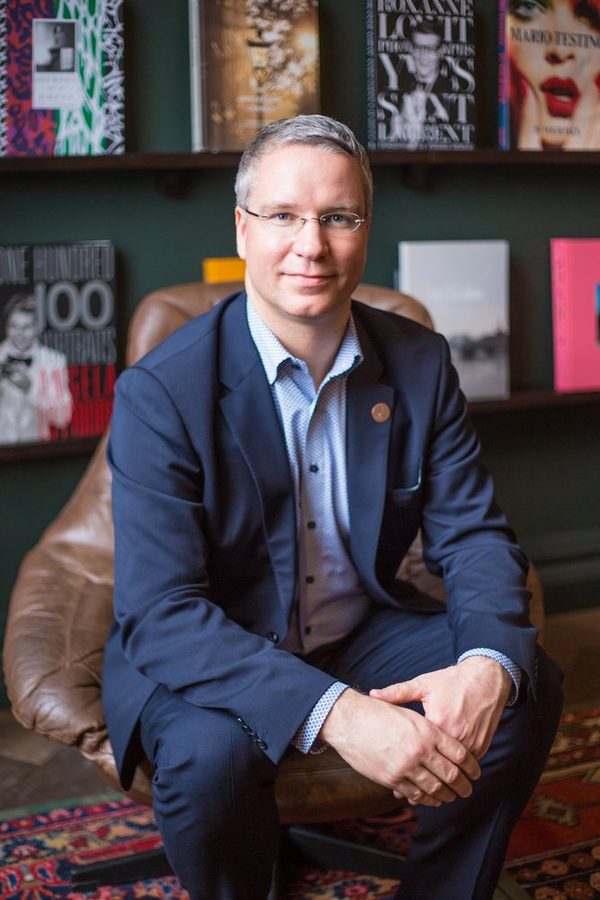
When I spoke with Alexander van Gastel, he was general manager of Pulitzer Amsterdam in the Netherlands. He has since become general manager of the Efteling Grand Hotel in Kaatsheuvel. He appears in a single chapter of The Luxury of Attention, on the creative act, and he is there because he described from inside a hotel’s onboarding the practice the chefs in the same chapter describe from inside their kitchens: a creative team is one that has been sent out to gather its own inputs.
Van Gastel grew up in a family of teachers in Asten, in the south of the Netherlands, in a house whose doors were always open to friends and neighbors. His first job in a hotel came at sixteen, serving coffee, tea and eggs on Saturday mornings in a property with twelve rooms. “I was hooked,” he told me. As a student he worked beside the owner and restaurant manager of a golf club across the German border, and at twenty he ran the entire night shift of an airport hotel at London Gatwick as a trainee, where he learned that a team’s respect has to be earned by working as hard as they do.
In Chapter 6, the book argues that the general managers and concierges who design the most distinctive guest experiences are the ones who have been the guest in the most rooms and walked the most competing properties. At the Pulitzer, that principle was built into the first days of employment. One of the concierges, the person who holds the keys to the hidden corners of the city, takes every new employee on a storytelling tour through the neighborhoods of Amsterdam, ending at the Canal House Museum to learn the history of the UNESCO canal belt the hotel sits inside. The purpose, in van Gastel’s words, is to train and empower every member of the team to become a storyteller, from the moment a booking is made to the porter’s walk to the room and the first breakfast.
“The concierge is now chief curator, as there is too much information online to sort through.” Alexander van Gastel, then general manager of Pulitzer Amsterdam
The concierge’s value, in his account, has moved from access to judgment. The creative pipeline at the front of the house starts with sending the team into the city and into the museum two blocks away, so that what they later offer a guest is something they have personally walked through.
The profile I published in 2017 shows the management posture underneath the tour. He does not micromanage, and he treats a wrong decision made in the guest’s interest as a lesson rather than a fault.
“It is important to give employees the freedom to decide, in whatever situation, what is in the best interest of guests. We never criticize such decisions, and whenever mistakes are made we treat them as learning opportunities.” Alexander van Gastel, in A Wealth of Insight (2017)
He also told me that he has come to weigh an applicant’s attitude over the resume, since knowledge can be imparted and an attitude towards people is harder to change, and that more than a third of his team had been with the hotel for over thirty years, teaching the company’s history to every recruit.
In the book, Alexander van Gastel appears in Chapter 6, The Creative Act, where the storytelling tour is the hotelier’s counterpart to the chef’s practice of gathering inputs from outside the kitchen, and where his concierge as chief curator stands beside Jonnie Boer’s claim that creativity belongs to the whole operation rather than to a single department. The front of the house, in his account, is a creative function with structured inputs rather than a transactional desk.
Alexander’s full profile, in his own words, runs ten pages in A Wealth of Insight: The World’s Best Luxury Hoteliers (2017).
Where Alexander is now
Now: General Manager of Efteling Grand Hotel (Kaatsheuvel, The Netherlands).
Career
- General Manager, Pulitzer Amsterdam, Amsterdam 2010-2019 (source, January 2010)
- Hotel Manager, The Westin Rotterdam, Rotterdam 2008-2010 (source)
- Food & Beverage Manager, Le Méridien Hotel des Indes 2002-2008 (source)
Training
- Graduated from Hoge Hotelschool Maastricht (source)
Checked 13 November 2026. Corrections are welcome at press@theluxuryofattention.com.
The full profile, in Alexander van Gastel's own words
This is the complete profile of Alexander van Gastel as published in A Wealth of Insight: The World's Best Luxury Hoteliers on Leadership, Management, and the Future of 5-Star Hospitality, reproduced word for word. Titles and positions are as they stood at the time of the interview.
Growing Up
I grew up in a family of teachers in a little town called Asten, in the southern part of the Netherlands. Hospitality has always been a part our family’s DNA. Our doors were always open to friends, family, and neighbors. We traveled a lot throughout the years, experiencing many different cultures, countries, and cities. I loved constantly meeting new people from different backgrounds.
A Passion for People
My first job in the hospitality industry was at age sixteen. Every Saturday morning, I served coffee, tea, and eggs in a small hotel with only twelve rooms. I was hooked. I realized my passion was working for and with people. Hotels have been magical for me ever since.
Learn as Much as You Can
During my studies, I worked at a golf club just over the German border. I was still a student at the time, but worked very closely together with the owner and restaurant manager. They taught me everything I needed to know about running a restaurant, from early morning shift until night. It was an invaluable real-time lesson in the restaurant business.
The most important thing people don’t realize about this industry is that the soul of a hotel is its people, not the design or technology. You need to create a team culture of belonging and pride to succeed.
Give Respect to Get Respect
My first real leadership position was at a four-star airport hotel in London Gatwick when I was fulfilling my Rooms Division internship. I was only twenty and as a trainee I was responsible for the entire nightshift. I learned how to deal with a variety of cultures and personalities, and realized that in order to earn your team’s respect, you must show them that you are working as hard as they are. Earning respect goes both ways.
The Freedom to Act
Do not micromanage your employees. Empower them to make decisions. It is important to give employees the freedom to decide, in whatever situation, what is in the best interest of guests. We never criticize such decisions, and whenever mistakes are made we treat them as learning opportunities. Even in such cases where the guest experience could be improved, staff are empowered to take action and resolve issues as they see fit. This stems from a culture of continuous improvement and striving for excellence. Many organizations are afraid to give such freedom to staff, but I believe it is critical to success.
Mentors Make a Difference
I had two mentors throughout my career that were critical in developing my professional life. Each took me under their wing. They believed in my abilities, trusted me to learn from my mistakes, and over time, entrusted me with greater responsibilities. Seek out people who are willing to advise you, guide you, and teach you. You will look back on such relationships as instrumental to your professional growth.
A Sparkling Personality
Over the last few years, I have focused less on an applicant’s resume and increasingly on attitude. Someone’s smile and sparkle, and their natural motivation, are extremely important. Knowledge can be imparted, but an attitude towards the industry, towards people, and towards life is harder to change. At the same time, you must be mindful of the various personalities on your team, and ensure any new hire will complement the others, including their potential manager.
Everyone a Storyteller
For new hires, we organize a range of interactive trainings and educational sessions, including games and role playing. Additionally, one of our concierges, who holds the key to all the hidden gems and secrets of the city, takes all new employees on a storytelling tour through the neighborhoods of Amsterdam. Lastly, they visit the Canal House Museum to learn about the history of the UNESCO canal belt, in which the Pulitzer Amsterdam is located.
This is part of our effort to train and empower all members of our team to become storytellers. It begins from the moment a booking is made to when they checkin physically, to when a porter guides them to their room, to when they sit for breakfast and beyond. We are constantly sharing interesting insights and happenings in and around the neighborhood. More than seventy employees, or a third of our team, have been with the hotel for more than thirty years. They know all of our regular clientele and teach the company’s DNA and history to all new recruits.
Millennials Like Change
It is important to understand the ambitions and goals of your team so you can tailor a professional development roadmap for each member. The younger generation in particular is eager to explore different positions after relatively short periods. It is important to understand their motivations and try to accommodate them to maintain interest and loyalty.
Raising the Bar
Over the last ten years, guests have rightly become more critical, and their expectations have increased. Prior to their arrival, they are already armed with vast amounts of knowledge about the property as well as the other properties in the area. This comparative insight puts every aspect of your hotel in the spotlight, for better or for worse. The bar has been raised across the board.
Invest in Human Resources
One of the biggest challenges in this industry is hiring the right person for the right job at the right time. To do this well, you must go beyond a human resources department, which primarily focuses on administrative tasks. You must invest in dedicated people who focus on training, development, and recruitment. Without the right people in place, you simply will not succeed.
Being a Good Neighbor
Pulitzer Amsterdam is located in the middle of the city, and we have more than 200 direct neighbors. Our relationship to them is critical to the success of our hotel. During a recent renovation of the property, we introduced the “Pulitzer Neighbor Discovery Card” to thank all those around us for their patience throughout this process. The card entitled them to a 15 percent discount at the hotel’s restaurant Jansz, Pulitzer’s Bar, and our lobby-garden café Pause. This proved to be a very successful way to engage our neighbors and show that we appreciate their partnership.
The Power and Peril of Social Media
In our industry, we need to understand social media and other digital platforms in a comprehensive way. It is not confined to a review on TripAdvisor. The younger traveler, in particular, shares their entire customer journey online—soliciting ideas on where to stay on Facebook, sharing their booking on Twitter, posting photos on Instagram, live-streaming their experiences on Snapchat and beyond. The influence of these platforms cannot be understated and is only expected to grow.
Hotels are put under pressure by individuals with a large number of social media fans and worldwide followers, most of whom have never stepped foot in your hotel. It is therefore hard for a hotel not to grant their wishes because they fear a negative review or experience would do far more damage than not complying. Everything shared is from the perspective of the poster, so two-sided context is rarely ever possible. Dealing with these kinds of situations is one of the biggest challenges we face as an industry.
Luxury Travel is Getting More Personal
Over the last three years, we have expanded the number of concierges at our property from four to six. Guests are increasingly interested in arranging activities and restaurant reservations far in advance of their stay, rather than upon arrival. This requires more manpower. At the same time, today’s guests are interested in connecting with a local expert who can guide them to hidden gems of the city not found or recommended online.
The concierge is now chief curator, as there is too much information online to sort through. They also serve to reaffirm the choices of travelers who have truly done their homework on how best to experience the city.
Suites that Transport Guests
As part of our recent renovation, our designer created five Extraordinary Suites, in which he had the freedom to completely customize the rooms to his own creativity. The five suites are story-based. We have the Book Collector’s Suite, the Antique Collector’s Suite, the Art Collector’s Suite, the Music Collector’s Suite, and the Pulitzer Suite. Each one transports guests into a truly special surrounding, embodied in history and culture. It is also a unique selling point, attracting many new guests to the hotel.
Going Above and Beyond
A certain percentage of our guests are marked as VIPs in the sense that they may be celebrating a special occasion, represent a particular travel agency, or have a specific occupation. They all receive a welcome surprise, but more broadly, we try to go above and beyond to create unique and memorable moments for all guests. For example, one of our guests loved the movie The Fault in Our Stars, which was filmed in Amsterdam. We sketched out a route for her through the city that covered all of the locations in the movie. We also have a kids’ program for all ages with a focus on the family travel, which includes personalized pillowcases, balloons, board games, travel diaries and more.
Different Origins, Different Preferences
Emerging market travelers are focused on A-list destinations such as Rome, Barcelona, Berlin, Paris, and London. They used to appreciate or even demand that their native breakfast be served at the destinations they were visiting. In a relatively recent shift, they are becoming more adventurous and open to experiencing local tastes. Such travelers spend more money on souvenirs, European brand clothing, and taking pictures to share on social media platforms. On the other hand, seasoned travelers are moving to more unique and secondary destinations, spending most of their money on the journey itself, like flying first class, staying in five-star hotels, and placing a value on experience rather than on possessions. Overall, customers are willing to pay for the convenience and comfort of a travel agent, as the use of travel advisors has skyrocketed.
The profile is one of the first person accounts collected in A Wealth of Insight: The World's Best Luxury Hoteliers (2017), the book that preceded The Luxury of Attention.