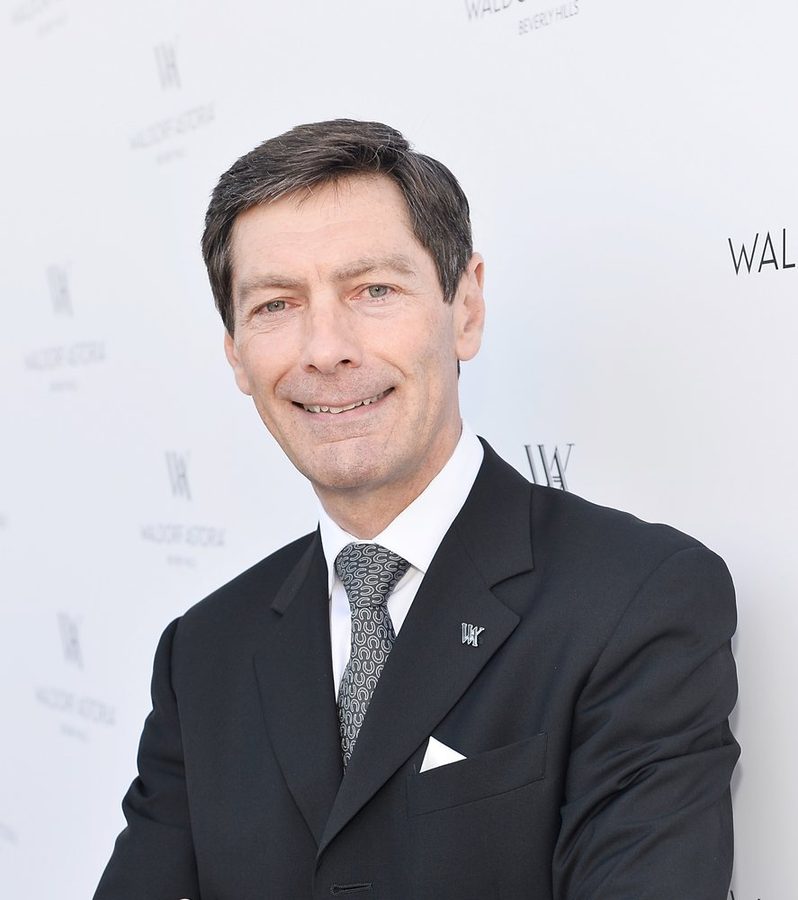
When I spoke with Luc Delafosse, he was managing director of Waldorf Astoria Beverly Hills in the United States. He has since become managing director of The Peninsula Paris. He appears in three of its chapters: in Chapter 1 for the moment behind the bar at the Savoy when his calling became specific, and later for one of the book’s working definitions. Hospitality, he told me, is the craft of knowing in advance what guests need and want, and that sentence carries the chapter on knowing the guest from its first page to its last.
The path
Delafosse grew up in the suburbs of Paris and in the countryside where his parents kept a summer home. He describes a simple life and one persistent ambition, which was to see the world. At fifteen he spent a summer working in a restaurant. While studying hotel management he cooked at a one-star Michelin restaurant, Auberge de la Poutre, under its chef and owner Denis Moureau, and learned there that he wanted the service side of the business rather than the kitchen.
The decisive image came at the Savoy in London, where he was working as a bartender. He would watch Willy Bauer, the general manager, walking the floor and talking with guests and staff, and he knew that was the job he wanted. A holiday conversation with the general manager of the Hotel de Paris in Monaco led to a post as chief steward and, within months, promotion into food and beverage management. From there came a hotel manager role at the Vista Palace in Roquebrune, where he project managed a full renovation, and later a general manager post building the Grand Hotel Le Touquet from the ground up. He draws one lesson from that stretch. Being pushed to lead before he felt ready made him rise to it, and he now challenges colleagues the same way.
What he is known for in the book
Delafosse describes the senior leader’s daily rhythm without embellishment. He walks the floor every day and speaks with colleagues in every position. He always eats lunch in the employee restaurant. He spends two hours each evening in the lobby and sits in on the morning line up meetings before shifts begin. His conviction is that a general manager has no business spending the day in a back office at a computer; the place to be is on the front lines, supporting the team. In the book I set this beside Peter Goossens’s insistence on giving 300 percent as the two postures that make the chapter on perfection work. The team can be brilliant, and the leader’s eye is still the final layer of inspection.
His second contribution is the definition of hospitality itself, and the clause that does the work is the first one.
“Hospitality is the craft of knowing in advance what guests need and want, and at the heart of this anticipation is the notion of an unforgettable relationship between our colleagues and our guests.” Luc Delafosse, then managing director of Waldorf Astoria Beverly Hills
In his own words
The earlier profile adds the discipline behind the walk. He is wary of management systems that keep leaders at their desks, and he credits most of what he knows to listening to owners, general managers and colleagues at the Savoy, the Ritz London and the Hotel de Paris.
“One of the most basic but incredibly important principles of leadership is to listen, and listen often. If you don’t listen, you don’t learn, and if you don’t learn, you cannot evolve as a leader.” Luc Delafosse, in A Wealth of Insight (2017)
What to take from him
Put the walk in the diary. Lunch with the team, two hours in the lobby, the morning line up. Delafosse treats these as fixed appointments, and the trust they build is the point.
Treat guest knowledge as a relationship held in confidence. Every guest entrusts their likes and dislikes to the property, and he expects that information to be protected and acted on before the next visit.
Challenge people past what they think they can do. He was hesitant before his first renovation and grew into it; he now asks the same of his colleagues and finds they surprise themselves.
Be discerning about anything new and shiny. Adopt a system or a technology only when you are sure it improves the guest or employee experience, and watch for the ones that pull managers off the floor.
In the book
Luc Delafosse appears in Chapter 7, In Pursuit of Perfection, where his daily walk of the floor is set beside Goossens’s insistence on giving 300 percent as the two postures that make the chapter’s argument, and in Chapter 9, Knowing Your Guest, where his definition of hospitality opens the discussion and returns at its close. Luc’s full profile, in his own words, runs 8 pages in A Wealth of Insight: The World’s Best Luxury Hoteliers (2017).
Where Luc is now
Luc Delafosse is Managing Director of The Peninsula Paris, France, a post held since March 2026. (source)
The hotel holds two MICHELIN Keys, a score of 92 in La Liste 2026 and the French Palace distinction.
Career
- Vice President of Hospitality and F&B Management, Al Khozama Group, Riyadh (source)
- Regional Vice President Europe and General Manager, Jumeirah Carlton Tower, London 2017 (source)
- Managing Director, Waldorf Astoria Beverly Hills, Beverly Hills 2015-2017 (source, 11 December 2015)
- General Manager and Managing Director, Hôtel de Crillon, A Rosewood Hotel, Paris 2010 (source)
- General Manager, Burj Al Arab, Dubai (source)
- Hotel Manager, later Managing Director, The Ritz London, London 1996-2003 (source)
Training
- Brevet de Technicien Hotelier (hotel technician certificate) and Ealing University, per eHotelier profile (source)
Checked 13 November 2026. Corrections are welcome at press@theluxuryofattention.com.
The full profile, in Luc Delafosse's own words
This is the complete profile of Luc Delafosse as published in A Wealth of Insight: The World's Best Luxury Hoteliers on Leadership, Management, and the Future of 5-Star Hospitality, reproduced word for word. Titles and positions are as they stood at the time of the interview.
Growing Up
I grew up in the suburbs of Paris and in the countryside where my parents had a summer home. I must say that our life was quite simple, but over the years I did dream of one thing—discovering the world. When I was fifteen, I spent the summer working for a restaurant, which was my first taste of the business. While studying hotel management, I served as a chef at the one-star Michelin restaurant Auberge de la Poutre, run by Chef-Owner Denis Moureau. I learned a great deal under his mentorship, but not long after, I realized that I really wanted to be on the service side of hospitality, and not in the kitchen. While serving as a bartender at the Savoy Hotel in London, I would witness Willy Bauer, the general manager at the time, walking the floor and interacting with both guests and employees. I realized that’s what I wanted to do.
When Opportunity Knocks
While leading the stewarding department at the Savoy Hotel in London, I went on vacation to Monaco and struck up a conversation with the general manager of the Hotel De Paris. An opportunity was presented—join their hotel as chief steward, and when a managerial position in food and beverage opened up, I would be strongly considered. I took the job, and only after a few months I was promoted to executive assistant manager of food and beverage. I realized that hard work pays off, but you must also capitalize on once-in-a-lifetime opportunities.
A Turning Point
Two years after serving as executive assistant manager of food and beverage at Hotel de Paris in Monaco, I received an offer to serve as hotel manager at the Vista Palace Hotel in Roquebrune-Cap-Martin in France. That was quite a special offer and one that would accelerate my career. The hotel was closed for renovations and I was assigned to project manage all aspects of the effort. Looking back, that was my first hotel opening, and one in which I was pushed to grow both personally and professionally. At first, I was very hesitant, but I realized that challenging me to lead prompted me to rise to the occasion. To this day I implement the same philosophy; challenge colleagues to do more, to be better, and to take on more responsibilities, and they too are surprised by how much they can achieve if asked to do so.
Success Follows Success
After learning the ins and outs of renovations and restorations, I had gained an incredibly valuable and important skillset in the world of luxury hospitality. Following a successful overhaul of the Vista Palace Hotel in France, I was approached by two investors based in the United Kingdom to be general manager of a new five-star hotel. It would be named the Grand Hotel Le Touquet, have 135 rooms and suites, and be built in Northern France. In this role, I deepened my renovation skills to include how to build a luxury hotel from scratch. As with any construction project, there were countless challenges and hiccups along the way, and often times you need to make very tough business decisions. But in the end, it was truly fulfilling to see this project to fruition and observing the experience of both staff and guests alike. You need to seek out and capitalize on opportunities that will expand and develop your skillets into new areas, even areas that you think are too hard to learn. It will all pay off in the long run.
True Hospitality
Hospitality is the craft of knowing in advance what guests need and want, and at the heart of this anticipation is the notion of an unforgettable relationship between our colleagues and our guests. This is a relationship that needs to be nurtured before, during, and after every guest visit. It is also a relationship built on trust. Every guest entrusts their likes and dislikes with you, and they expect that information to not only be held in confidence, but to be acted upon and used to anticipate future requests.
A Lifelong Journey
One of the most basic but incredibly important principles of leadership is to listen, and listen often. If you don’t listen, you don’t learn, and if you don’t learn, you cannot evolve as a leader. A great hotel starts with a great owner, and I was blessed to have learned from the best. Whether at the Savoy Hotel in London, the Ritz London, or Hotel de Paris in Monaco, I took the opportunity to listen to everyone around me. To this day, I can say that I learned most of what I know on the job and through interactions with general managers, owners, investors, and other colleagues that I keenly observed and listened to. Always be open to new ideas, new ways of thinking, and new ways of doing business. It’s a lifelong journey.
On the Frontlines
My style of management is to create a relationship with each and every employee from day one. I walk the floor daily and speak to colleagues across the property in all positions. I always eat lunch at the employee restaurant, and spend two hours every evening in the lobby. I also spend a bit of time each morning attending line-up meetings with staff about to start their shift. Being visible, approachable, and engaged with your team is the only real way to build positive, trusting relationships rooted in open communication. As a general manager, you need not spend your time in the back office at a computer. You need to be on the frontlines supporting your team in every way possible.
A Strategic Shift
When I joined this industry thirty years ago, the general manager was fully in charge of his or her hotel, operations, and team. Over this period, however, we have seen a substantial shift with the involvement of asset managers, investors, and management companies. As a result, the vision and key strategic decisions are made at another level, and thus the general manager of today is more of an executor of that direction than an architect of it. This has also muddled the industry a bit in that it used to be known as the hotel business, and now it’s more the business of hotels. Often times what is required to be successful in this industry is not aligned with the expectations or needs of owners, which can create friction.
(not) Adding Value
Do not implement a new technological system or management philosophy unless you are absolutely sure that it will enhance the employee or guest experience. We see new ways of doing things all the time, and you must be incredibly discerning before putting anything new and shiny into practice. These systems—Value Engineering, Optimization Management, Total Employee Involvement, Zero Defect, and others—need to be fully evaluated before adopting. I believe such systems tend to keep managers in their back offices rather than on the floor, where they are supposed to be.
Tennis in the Sky
One of the most innovative marketing campaigns I was involved in was when we were preparing for the Dubai Tennis Tournament, and we were conducting a photo shoot on the helipad of the Burj Al Arab hotel. An idea was born. We approached two very famous tennis champions staying at the hotel— Roger Federer and Andre Agassi—with the suggestion of creating a tennis court on the helipad for them to play a friendly match. They were both ecstatic and immediately agreed. It was a breath-taking scene that CNN broadcasted in near real time to its live, global audience. To this day, it is fondly remembered as a stroke of genius.
The New Standard
Today, there are a number of practices that have become standard to five-star luxury hotels. At check-in, guests are offered pressing services, newspapers, and preferred drinks. Guests are also guaranteed reservations in the restaurant and spa, and turn-down is a full-service offering with amenities refreshed, chocolate, night or hand cream, and more. Check-in time is whenever the guest arrives, and a late check-out is now expected.
Constant Contact
The next generation expects new services and offerings mediated by technology. Now, through in-room tablets, guests can order meals, request that their car be ready at the entrance, and send messages directly to the concierge team. We’ve also implemented a concierge texting service to all of our guests to stay connected in real time, wherever they are. These kinds of communication tools are becoming part of the hotel experience.
Knowing the Source
While gastronomy has always been an important part of the hotel experience, travelers do not necessarily want fine dining all the time. The quality of produce and other ingredients are becoming increasingly important. Today’s chefs must communicate where they purchase their product because guests are now very much interested in supporting local farms and sustainable practices. The standard for quality food at any time during the day or night has also been elevated in recent times. In addition, in the past, chefs would mostly remain in the kitchen, despite how much they were celebrated in books and magazines. Today, customers are interested in meeting the chef to express their appreciation of his or her talent.
The profile is one of the first person accounts collected in A Wealth of Insight: The World's Best Luxury Hoteliers (2017), the book that preceded The Luxury of Attention.