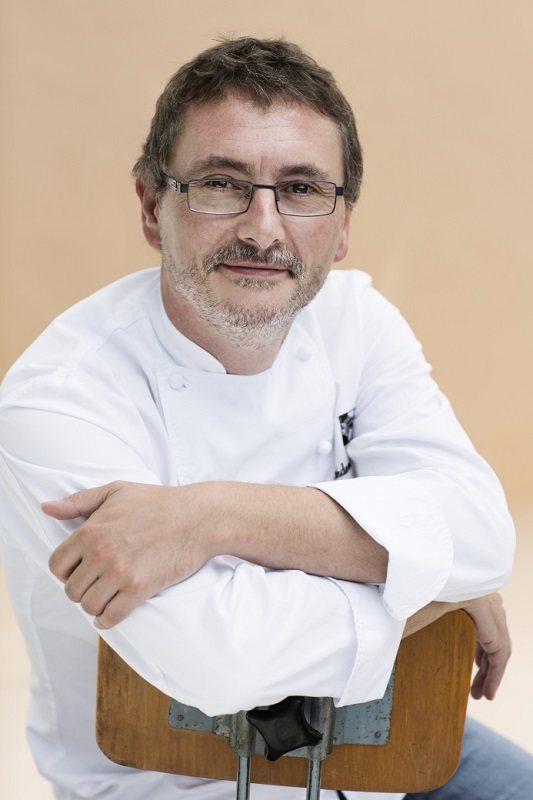
When I spoke with Andoni Luis Aduriz, he was the chef of Mugaritz in San Sebastián, Spain, a restaurant that The World’s 50 Best has placed among the top ten in the world for fourteen consecutive years, and he still is. He appears in a single chapter of The Luxury of Attention, and he is there because he gave the book’s argument about creativity a longer reach in time than anyone else I interviewed.
He did not choose the kitchen. He was a bad student, and when he finished secondary school at fourteen he had no vocation in sight. His mother had lived through the Spanish Civil War and known hunger, and she enrolled him in culinary school so that he would always have enough to eat. His first kitchens were run by the kind of chef he describes as perpetually cruel, and his first thought was how he was going to survive. He says he was very ineffective, and that he used to run away because the chef, on account of his weight and age, could not catch him. Later, at elBulli, the wars in the Balkans led him to a conclusion he has built his career on: each of us holds the best and the worst, and which one comes out depends on the context. He has devoted himself since to building a kitchen in which a team’s skills and virtues can blossom.
Chapter 6 sets out, through Alex Atala, the claim that new dishes grow from a foundation of classical knowledge. Aduriz extends that claim across centuries. Gastronomy, he told me, is knowledge that has been sedimenting over time. The chef working today works on top of accumulated technique, ingredient knowledge and cultural meaning, and the dish that looks entirely new is, with very few exceptions, a recombination of what was already there.
“Any dish viewed in the context of history will give us clues about the depth of its possibilities.” Andoni Luis Aduriz, chef of Mugaritz, San Sebastián
Mastery, as I put it in the book, is moving inside that sediment with enough fluency to produce recombinations that feel fresh without being arbitrary. A cook who has not absorbed what came before produces novelty that is incoherent. A cook who has absorbed it and stopped produces the past in new clothing. Aduriz works in the narrow space between the two, and he is frank that his profession is meant to treat tradition as a reference and then ignore it.
What a manager can take from his profile is his account of where inspiration comes from. A word, a gesture, a glance, an emotion, a technique or an ingredient can each start a dish; one Mugaritz dish began with a picture of sixteenth century Venice and the word decline.
“When you are trained to discover beauty, you can find beauty in everything. Creativity, therefore, is an attitude by which you discover.” Andoni Luis Aduriz, in A Wealth of Insight (2019)
He is equally clear about measurement. Mugaritz, he says, must be measured against itself, and the key to twenty years at the top with limited resources has been refusing to be led astray by awards, compliments or critics.
In the book, Andoni Luis Aduriz appears in Chapter 6, The Creative Act, where his observation about sediment follows Atala’s foundation of knowledge and gives the chapter its account of creativity as fluent movement within an inheritance rather than a break from it. Andoni’s full profile, in his own words, runs six pages in A Wealth of Insight: The World’s Best Chefs (2019).

Where Andoni is now
Andoni Luis Aduriz is Chef Patron of Mugaritz, Errenteria, Spain, a post held since 1998. (source)
The restaurant is No. 87 on The World's 50 Best Restaurants 2025, and holds two MICHELIN stars.
Career
- Head Chef, Martín Berasategui restaurant, Lasarte 1996 (source)
- Member of the team, El Bulli 1993-1994 (source)
Training
- Catering School of San Sebastián (studies completed before working with several Basque and Spanish chefs) (source)
Recognition
- Icon Award, The World's 50 Best Restaurants (2023) (source)
- Chef's Choice Award, The World's 50 Best Restaurants (2012) (source)
- Best Chef Science Award, The Best Chef Awards (2022) (source)
- Winner, Spanish championship for young chefs (1995) (source)
- Mugaritz holds two Michelin stars (recognised since 2006) (2006) (source)
Checked 13 November 2026. Corrections are welcome at press@theluxuryofattention.com.
The full profile, in Andoni Luis Aduriz's own words
This is the complete profile of Andoni Luis Aduriz as published in A Wealth of Insight: The World's Best Chefs on Creativity, Leadership, and Perfection, reproduced word for word. Titles and positions are as they stood at the time of the interview.
Never Without Food
I was a very bad student in secondary school. When I finished at 14 years old, I had no vocation in sight. My mother was very worried about my future, knowing I could follow the wrong path. She lived during the Spanish Civil War and suffered hunger and hardship. She wanted to be sure that I had enough to eat every day so she enrolled me in culinary school to become a chef.
How Am I Going to Survive?
My earliest experiences in the kitchen were rather traumatic. I was 14 years old and, at the time, had only worked in simple restaurants and hotels. Seared in my memory is the always angry, dirty curmudgeon chef that was perpetually cruel. The first thing I thought was how am I going to survive? I was very ineffective. I used to run away because the chef, due to his weight and age, could not catch me.
Becoming a Leader
You can have a perfect command of language and speak very well, but if your actions do not align with your words, you are incoherent. This is not always the case, as sometimes your words express one thing and your actions express another, but when this happens, you will be remembered for your actions. You must understand this fact in order to become a leader.
Creating a Positive Ecosystem
My time at elBulli coincided with the Balkan Wars after WWII. Apart from the ongoing atrocities, it was a war that we could empathize with because it was happening to people like us. All of this made me think that, logically, inside each of us resides the best and the worst. We are capable of both good and bad. If the context is appropriate to use all of our skills and creativity to inflict damage, then those skills would be activated as such. I came to the conclusion that we needed to create an ecosystem or an appropriate context in which all the skills and virtues of our team would blossom. I have since devoted myself to creating an environment that encourages creativity, loyalty and companionship in each person.
Measuring Success
The success of Mugaritz must be measured against itself. We have the challenge of being true to the legacy. It’s not easy to work for 20 years in a highly competitive environment with limited resources, and be considered one of the top ten restaurants in the world for the past 13 years. Places like Mugaritz are a kind of high-performance center, where there are no limits to rigor. The job is incredibly demanding. The key is not to be led astray by awards, compliments or critics.
Creativity as a Bridge
Gastronomy, generally speaking, is knowledge that has been sedimenting over time. Any dish viewed in the context of history will give us clues about the depth of the relationship humans have had with food. For instance, the seemingly simple relationship between human and tomato will surprise us because there was an original intent to create a product, underpinned by technology, desire and culture. Gastronomy needs many explanations to understand this complex relationship, and creativity can serve as a bridge to uniquely explain, manage and convey that connection.
Inspire Me
Inspiration can come from a word, a gesture, a glance, an emotion, a technique or an ingredient. When you are trained to discover beauty, you can find beauty in everything. Creativity, therefore, is an attitude by which you discover. For example, lightness or decline are words that can serve as inspirations. In Mugaritz, we made a dish which evoked decline. The idea came from a picture: a scene that reflected 16th century Venice.
The Perfection Vacuum
If you were to ask what the perfect meal was, my mind would immediately move to recreating, to some extent, what I already know and what belongs to my culture. Perfection is relative to the person. It does not exist in a vacuum.
The Reality of Change
Jacques Cousteau used to say that a tradition, in order to be a tradition, must adapt to new times. It is very difficult to find static traditions. In gastronomy, diasporas are often guardians of tradition because food serves as a unique reference to the origins people want to defend. Gastronomy, more generally, is constantly changing. It is not a good nor bad thing. It is just reality. Tradition has its place and we must respect it, but I work in the field of creativity. For me, tradition serves as a useful reference, but my profession is meant to ignore it.
A Curious Dish
One way to create a new dish is from the perspective of curiosity. I enjoy discovering new products, techniques and processes, but I enjoy it even more when I find something that challenges what I already know.
For example, I remember a dish that I ate in Japan that had a base of tasteless rice. It was shocking because it reminded me of hospital food. The great thing about that dish was that it contained puffer fish gonads and they are one of the most amazing products I know. They were made yakitori style with a bit of salt. It was truly spectacular. The contrast between the blandness, hot, very hot and creaminess of that product together with the salt was pure luxury and a very exciting moment for me. I would never have expected that such an extreme blandness was something those chefs would specifically look for, and this realization moved me.
A Reflection of Society
We as a society now know and recognize the implications that eating has on the life we live, the way in which we behave and the impact these actions have on the planet we inhabit. Therefore, I believe we are moving towards a more responsible gastronomy, which reflects the overall movement of society to more responsible living.
The profile is one of the first person accounts collected in A Wealth of Insight: The World's Best Chefs (2019), the book that preceded The Luxury of Attention.