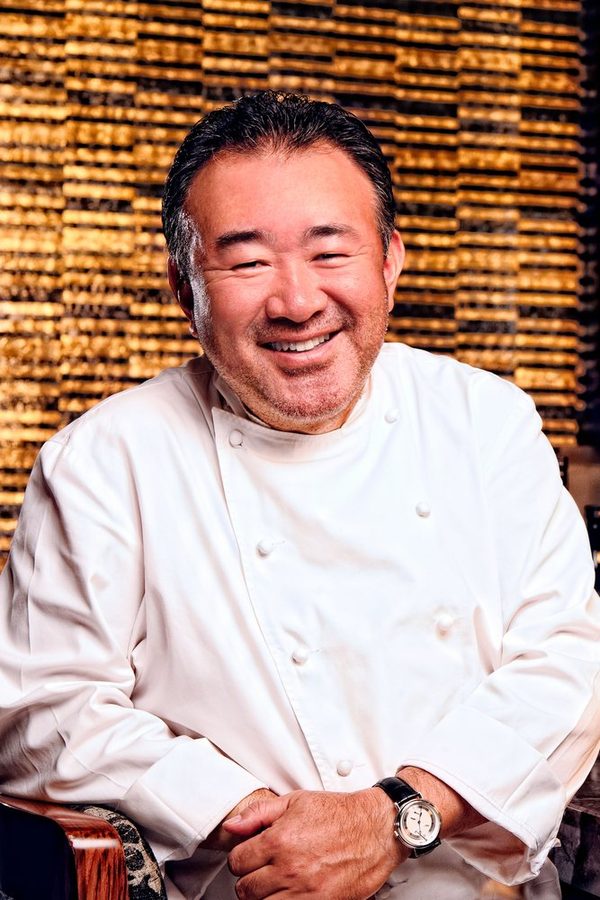
When I spoke with Tetsuya Wakuda, he was running Waku Ghin at Marina Bay Sands in Singapore, the restaurant he opened after decades at Tetsuya’s in Sydney. In The Luxury of Attention he answers one question, and he answers it more plainly than any other chef I interviewed: where does a chef’s creativity come from?
Wakuda was born in Hamamatsu, in Japan’s Shizuoka Prefecture, and moved to Australia at the age of 22 to work as a kitchen hand in a Sydney restaurant. He arrived, by his own account, with no language, no cooking skill and no knowledge of food or technique, only curiosity and a wish to learn. The kitchen belonged to Tony Bilson, who showed him what he did and taught him a great deal about French cooking. Wakuda went on to run Tetsuya’s in Sydney for decades with nearly everything under his own control: the building, the business, the sourcing. Opening Waku Ghin inside an integrated resort was, he says, like joining a village. He had to learn from scratch how to build relationships with management, with other chefs and with their teams, after years of answering to nobody.
What he speaks to in Chapter 6, The Creative Act, is the source of new work. The answer the interviews gave me, almost without exception, is that it comes from outside the kitchen. The chefs who create most fluently are the ones who spend the most deliberate time away from the range, at markets, in museums, inside other people’s restaurants, in countries whose cooking they did not grow up with. Wakuda put it directly.
“Creativity is rooted in curiosity. From the very beginning of the culinary process, when we start sourcing ingredients, creativity is a driving force. When I travel and visit restaurants, I pay close attention to the ingredients they use.” Tetsuya Wakuda, chef of Waku Ghin at Marina Bay Sands, Singapore
I took that as research rather than holiday. No particular output is expected from it on the day. A chef who works this way has learned that the inputs to next year’s menu are gathered this year and the year before, in places that do not look like work. In his earlier profile he describes what happens after the noticing. A great flavor or scent sets him wondering how to bring it into his menu and what dish the ingredient could make, and a new dish at Waku Ghin almost always starts with an ingredient he enjoys, elevated with simple flavors and nothing that pulls focus from it.
The same profile is clear that none of this is a solo pursuit, and this is the line I would give a manager.
“I believe that when everyone is clear on their responsibilities and our common goals, and they perform their best, we can achieve greatness.” Tetsuya Wakuda, in A Wealth of Insight (2019)
His team comes from different backgrounds and different training, and what aligns them, he says, is a shared love of food and a shared wish to give guests the best possible experience. The chef who goes out collecting curiosity returns to a kitchen that knows its responsibilities well enough to turn what he found into service.
In the book, Tetsuya Wakuda appears in Chapter 6, The Creative Act, where his account answers the chapter’s question about where the chefs who create most fluently spend their deliberate time, and where his is one of the clearest statements that curiosity is the raw material and the chef has to go and collect it. I placed him there because he describes the habit as a routine part of the work rather than as a break from it. Tetsuya’s full profile, in his own words, runs 6 pages in A Wealth of Insight: The World’s Best Chefs (2019).
Where Tetsuya is now
Tetsuya Wakuda is Chef-Owner of Waku Ghin at Marina Bay Sands, Singapore, Singapore. (source)
Career
- Owner and Head Chef, Tetsuya's, Tetsuya's restaurant, Sydney, Sydney 1989-2024 (source, 14 May 2024)
- Partnership with Kinsela's former Head waiter, Ultimo's, Sydney 1984 or 1987 (source)
- Sushi specialist, Kinsela's, Sydney 1982-1984 (source)
- Kitchen hand, Fishwives restaurant, Sydney 1982 (source)
- Trainee Hotel Chef, Hotel in Hamamatsu, Hamamatsu (source)
Training
- Trained as a hotel chef in Hamamatsu, Japan, before coming to Australia (source)
- Learned classical French techniques while working under Tony Bilson at Kinsela's in Sydney (source)
Recognition
- Medal of the Order of Australia (OAM) (2005) (source)
- Master of Cuisine award from the Japanese government (2013) (source)
- Diners Club Lifetime Achievement Award, Asia (Asia's 50 Best Restaurants) (2015) (source)
- Relais & Châteaux Grand Chef (source)
- One Michelin star for Waku Ghin (Marina Bay Sands), stated for 2024 and 2025 (operator page also lists two stars for 2017-2019, 2021-2023) (2024) (source)
Checked 13 November 2026. Corrections are welcome at press@theluxuryofattention.com.
The full profile, in Tetsuya Wakuda's own words
This is the complete profile of Tetsuya Wakuda as published in A Wealth of Insight: The World's Best Chefs on Creativity, Leadership, and Perfection, reproduced word for word. Titles and positions are as they stood at the time of the interview.
Teach Me Everything
I moved to Australia at the age of 22 and started as a kitchen-hand in a restaurant in Sydney. At the time, I had no language skills, no cooking skills, and no knowledge of food or techniques, but I was very curious and keen to learn. This was the beginning of my journey. I remember being in this big, beautiful kitchen of legendary chef Tony Bilson. He showed me what he did and I was fascinated. He was an enormous influence on me and I learned a lot about French cuisine.
I thrive on being able to serve my guests something I’ve created from inspiration to table.
Our Love of Food
Running a restaurant is not a solo effort. Everyone on the team contributes to make it work. All of us have come from different backgrounds, studied different methods and grown up in different environments. Despite these differences, all of us are aligned in our love of food, and all of us desire to bring the best possible dining experience we can to our guests. I believe that when everyone is clear on their responsibilities and our common goals, and they perform their best, we can achieve greatness.
Core Philosophy
The act of cooking is a gift from the chef to the diner. This philosophy remains constant regardless of any awards or recognition we may receive. Every single day at Waku Ghin, we continue to do what we believe in, which is to source the best possible ingredients from around the world and deliver them to guests with the highest standards of service.
Joining a Village
At Tetsuya’s in Sydney, almost everything was under my control—the building, the business and the sourcing. In not so many words, I was in charge. But when I opened Waku Ghin at Marina Bay Sands in Singapore, it was a very different experience as it was like joining a village. We are a community of restaurants and I had to learn to build relationships with management, fellow chefs and their restaurant teams. Having run Tetsuya’s on my own for decades, I had to start learning from scratch about how to operate a restaurant in a large-scale, integrated resort.
I Begin to Wonder
Creativity is rooted in curiosity. From the very beginning of the culinary process, when we start sourcing ingredients, creativity is a driving force. When I travel and visit restaurants, I pay close attention to the ingredients they use. And every time I experience something interesting—for example, a great flavor or scent—I begin to wonder. How do I incorporate this into my menu? What type of dish can I make using this ingredient? Different cuisines and cultures open up our minds and sharpen our insights about the endless possibilities in the kitchen.
The Tender Spot
Ingredients are at the center of all my creations. When I am inspired to create a new dish, it usually starts with an ingredient that I personally enjoy. Once we have that ingredient, we try to elevate it with simple flavors that enhance the texture and taste—nothing too complicated that takes away the focus.
For example, Tasmanian ocean trout is fantastic. Grilled or oven-baked, the taste and texture come together perfectly. The sides and surfaces would be fully cooked, but the pinkish portion in the middle—the tender spot—always tasted the best. This is what sparked the creation of the Ocean Trout Confit served at Tetsuya’s. I wanted to replicate that same tenderness in the middle throughout the whole dish.
of Tetsuya
Pursuit of Perfection
As chefs, we always aim for perfection, but there is no such thing as a perfect dish in this world. Everyone has different preferences and taste buds, and that is what makes working in this industry so interesting. It’s a constant process of change, evolution, and refinement. Setbacks are not the result of creative failure. They are opportunities to improve and tweak, and to make the dining experience better for our guests.
The Perfect Meal
More than 20 years ago I dined at an eight-seat restaurant named Kahala in Osaka, Japan, and this dining experience was the closest to what I would describe as a perfect meal. It was an amazing experience unlike any other. The creativity, taste, and precision in the culinary craft hit just the right spot for a truly memorable experience that I still cherish today.
The Simpler the Better
In the future, I believe simple dishes will take the hearts of diners. There will be less complicated methods and less garnish without sacrificing taste. While there is a growing appreciation for premium ingredients, diners still prefer to taste ingredients in all their naturalness and without much embellishment. Over the years, I’ve learned that great cuisine comes not from elaborate cooking but from fresh ingredients and unadorned techniques. This idea also aligns with our aging society. Everyone is more health-conscious and prefers gentler flavors.
Shared Earth
Sustainability is at the top our list as chefs. It’s about maintaining a natural balance between enjoying the gifts of nature and giving back to the environment. Even as we source fresh, natural produce for our cuisine, we want to do it in a way that protects the natural ecosystem so that it continues to thrive. In Australia and New Zealand, most seafood are farmed to minimize the threat of overfishing to the natural marine ecosystem. There is also a cap quota for the farming and supply of ingredients like scampi and crayfish.
Many years ago, I started the Petuna Ocean Trout breeding program in Tasmania to educate people to produce ocean trout in an ethically-responsible way. Among its many sustainability measures, Petuna produces ocean trout at a low pen density, so that they have room to move and are therefore healthy and stress-free. Today, Ocean Trout Confit is one of our signature dishes at Tetsuya’s in Sydney.
More Seafood, Less Meat
In Singapore, Waku Ghin sources from the best and most environmentally-friendly suppliers, and focuses on less-resource intensive sources of protein—favoring premium seafood over animal husbandry. Our hojicha, or Japanese green tea, is sourced from a certified supplier from Kyoto, and the restaurant’s seaweed is naturally harvested as well.
The Whole Experience
Having a career in the culinary industry requires more than simply knowing how to cook. We must have deep knowledge of beverages and service, too. People eat for the experience, so we must consider the whole experience when we look for inspiration and how best to improve our craft. It’s also important to track the evolving taste buds of guests, and keep an eye out for new taste profiles and ingredients that can be further explored and enhanced. If you’re in this industry, you must love to eat, to taste, and to experiment, and you must retain this natural curiosity to continually improve.
The profile is one of the first person accounts collected in A Wealth of Insight: The World's Best Chefs (2019), the book that preceded The Luxury of Attention.