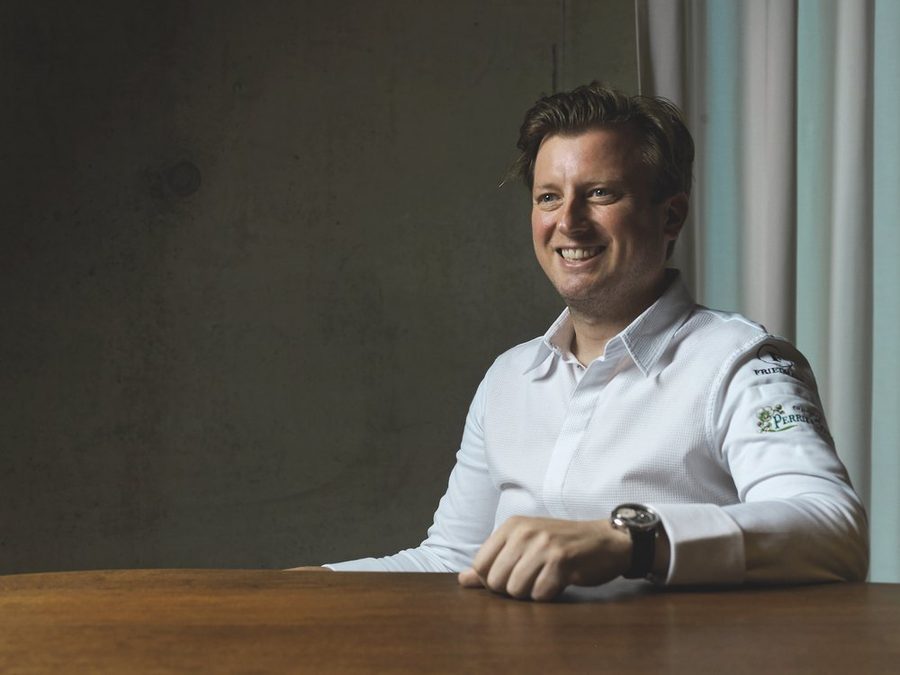
When I spoke with Kevin Fehling, he was the chef behind The Table in Hamburg, Germany, a restaurant holding three Michelin stars and run without an investor or a hotel parent behind it. That independence is rare among the chefs in The Luxury of Attention, and it is the reason he is in the book: his kitchen shows what empowerment looks like when there is nobody else to carry the load.
Fehling was born in Delmenhorst and grew up on traditional northern German cooking made by a mother who often held three jobs at once and still found time to put fresh meals on the table. What sent him into kitchens, he told me, was the wish to prove that it is possible to do something extraordinary in life. His first job was at the Park Hotel Bremen, then one of Germany’s grand hotels, under a chef with an awful temper who nonetheless taught him to value luxury products and their proper preparation. He worked a split shift, and during the afternoon break he would sit in his apartment wondering whether to go back that evening. “Ultimately, I had a larger goal in mind that brought me back to the kitchen every night.”
In Chapter 5 he describes his position plainly. He is a solo entrepreneur with no investor or hotel as security, in a segment where most gourmet restaurants survive only through one or the other. A chef who answers only to himself and his guests cannot afford to be the bottleneck through which every decision passes. So his team handles the daily decisions the chef cannot personally handle, and he keeps for himself the few that genuinely need his voice: menu direction, ingredient sourcing, the shape of the guest experience. I set his kitchen beside Mahmoud Skaf’s hotel in Kuala Lumpur, where empowerment is framed as a business decision. The two operations look nothing alike, and the discipline beneath them is the same. Many large hotel kitchens could learn from a model that necessity forced into being.
His earlier profile shows the economics that make the discipline unavoidable. Because The Table serves a fixed menu to the same number of guests every day, he can cost every meal exactly and order without surprises, and he charges the true cost of the menu where many restaurateurs are reluctant to.
“For us to remain successful we must continuously evolve creatively, take very well care of our team, and win the monthly financial battle that comes with running a three Michelin star restaurant.” Kevin Fehling, in A Wealth of Insight (2019)
The second thing he speaks to is perfection. Chapter 7 asks the chefs whether a perfect dish exists, and Fehling brings the question back to the working cook’s daily reality.
“I don’t think chefs can ever achieve perfection, since every three Michelin star cook has his or her own unique, signature style. Our profession is very subjective, so I don’t think there can ever be a perfect dish, and yet we have this desire and passion to constantly seek perfection.” Kevin Fehling, chef of The Table, Hamburg
The seeking, in his framing, is the posture that produces the work year after year rather than a failure to arrive. He does believe in perfect recipes, and a new dish goes on the menu only when he is certain it is better than the one it replaces. His eel, prepared in an old Japanese style, took two years to get right.
In the book, Kevin Fehling appears in Chapter 5, Giving the Keys, where his kitchen stands beside Mahmoud Skaf’s hotel as two operations that look nothing alike on the surface and run on the same discipline beneath, and in Chapter 7, In Pursuit of Perfection, where he brings the question of the perfect dish back to a subjective profession in which every three star cook has a signature of their own. Kevin’s full profile, in his own words, runs six pages in A Wealth of Insight: The World’s Best Chefs (2019).
Where Kevin is now
Kevin Fehling is Chef Patron and Head Chef of The Table Kevin Fehling, Hamburg, Germany, a post held since August 2015. (source)
The restaurant holds three MICHELIN stars.
Career
- Head Chef, Restaurant La Belle Epoque, Columbia Hotel, Travemünde 2005–2015 (source)
- Head Chef, Restaurant Venezia, MS Europa 2000–2001 (source)
Training
- Apprenticeship as a cook at Hotel Thomsen, Delmenhorst (completed 1997) (source)
Recognition
- Three MICHELIN stars for The Table Kevin Fehling (2020) (source)
- Three MICHELIN stars for restaurant La Belle Epoque (Guide Michelin 2013 edition) (2013) (source)
- Restaurant des Jahres (Der Feinschmecker) for The Table (2015) (source)
Checked 13 November 2026. Corrections are welcome at press@theluxuryofattention.com.
The full profile, in Kevin Fehling's own words
This is the complete profile of Kevin Fehling as published in A Wealth of Insight: The World's Best Chefs on Creativity, Leadership, and Perfection, reproduced word for word. Titles and positions are as they stood at the time of the interview.
Something Extraordinary
I’ve always been interested in the food industry. My mother, who often had three jobs at once, raised us two kids with the support of our father, and somehow always found time to cook fresh meals for us. At home we always had traditional, northern German cuisine prepared with love. What propelled me to become a chef was something else, though: I wanted to prove to myself and others that it’s possible to do something extraordinary in life.
Reached My Limits
My first professional experience was in the Park Hotel Breman which, at the time, was one of Germany’s grand hotels with a kitchen to match. The chef, Bernhard Stumpf, had an awful temper, but he also had a fascinating way of teaching me to value cooking by properly appreciating luxury products and their perfect preparation. I worked a split shift, meaning half a shift in the morning and half a shift in the evening.During the break I always sat in my apartment wondering whether I should go back that evening. Ultimately, I had a larger goal in mind that brought me back to the kitchen every night.
Solo Entrepreneur
The biggest challenge to leading a restaurant like The Table is to establish the restaurant economically. Most gourmet restaurants in the high-end segment generally only survive through an investor or are part of a luxury hotel. I’m a solo entrepreneur and have no investor or hotel as security. My main challenge is to follow through with the original business plan—to fill up the restaurant every day. For us to remain successful we must continuously evolve creatively, take very well care of our team, and win the monthly financial battle that comes with running a three Michelin star restaurant.
The True Cost
We can do something extraordinary with the best salmon, for example, by giving the fish a certain taste through a particular cooking process. That means we do simply hunt for luxury products. With our restaurant concept at The Table, we can calculate the cost of each meal perfectly because we only offer a fixed menu and cook for the same number of people every day. Therefore we always know what quantities have to be ordered and there are no negative surprises in the evening. Many restaurateurs are reluctant to demand the true cost of the menu price, but you must in order to act economically.
Trust Your Instinct
Since my cooking style is open-minded and modern, creativity plays a very big role in my life. The creative process is continuous and requires discipline. I sleep with it in the evening and wake up with it in the morning. The older I get, the more I realize that it doesn’t always depend on a specific combination of flavors and textures, but rather a steady building of trust in my own creativity. For me, creativity is linked to emotional intelligence, while manual labor is linked to rational intelligence. I’m very grateful that I have more emotional intelligence than rational, which allows me to understand art, but I believe true artistic abilities cannot be learned.
Mind to Plate
When creating a new dish, we start off with an idea and then I draw multiple variants of that idea on paper. Often, a dish can be made of up to 15 different recipes that have been combined into one. The perfect arrangement, or visual presentation of the idea, and the choice of plates are also decided and created at this stage. The dish is then cooked and tested as long as it takes until I consider it perfect. When you decide to put a new dish on the menu, you must be 100 percent certain that it’s even better than the one being replaced.
On the Menu
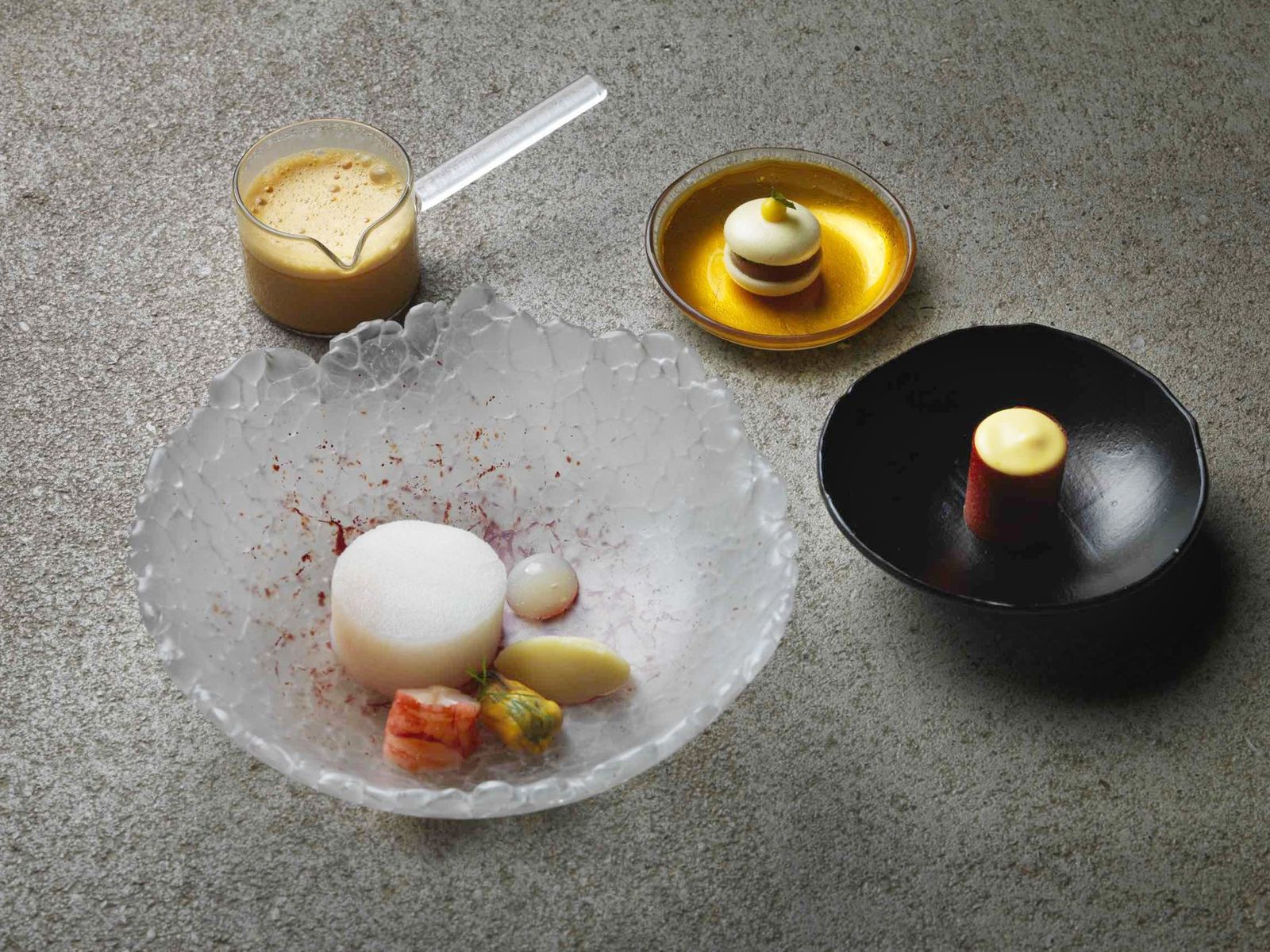
We continue to develop the classic combination of strawberry, rhubarb and almond, and every year we find a more perfect garnish to accompany a different protagonist—currently the scallop. We also have an eel that is prepared according to an ancient Japanese technique. It took me two years to perfect this dish. The fresh filet is first grilled, then cooked soft in water, soy sauce, mirin, rice vinegar and sugar, and glazed with a reduced fond and then grilled again.
A Scent of Inspiration
Inspiration for creating new dishes can come from anywhere. It could come from my daughter dropping a bottle of Marc Jacobs perfume into my wife’s bath. That gave me the idea to put the taste and smell of that perfume on a plate, and also to build the architecture of the dish to look like that perfume bottle. Inspiration could also come from the traditional cooking of my mother, which has been ingrained in me since childhood. For example, at The Table we have done a modern interpretation of kale with cooked sausage, pinkel and cured pork.
Limitless Creativity
The whole planet is inspiring. I sailed across the sea in 2000 and 2002, and got to know the whole world. I’ve been inspired ever since. Limiting myself to a 50km or 100km radius for product selection means limiting myself creatively. For me, if you limit yourself physically, you limit yourself mentally.
The Nature of Perfection
I don’t think chefs can ever achieve perfection, since every three Michelin star cook has his or her own unique, signature style. Our profession is very subjective, so I don’t think there can ever be a perfect dish, and yet we have this desire and passion to constantly seek perfection. I do believe there are perfect recipes, which takes us back to the rational side of manual labor. Creating the perfect dish is not a battle, but a goal.
The Future of Food
I don’t follow any trends since it’s important for me to always set my own standards. More broadly, the progress of cooking techniques will be a little slower, since Ferran Adrià already set the standards for technique over 15 years ago, and was several years ahead of his contemporaries. Now and in the coming years, we will continue to profit from his wisdom. In addition, we must continually remind humanity that we do not have endless resources on this planet.
The profile is one of the first person accounts collected in A Wealth of Insight: The World's Best Chefs (2019), the book that preceded The Luxury of Attention.