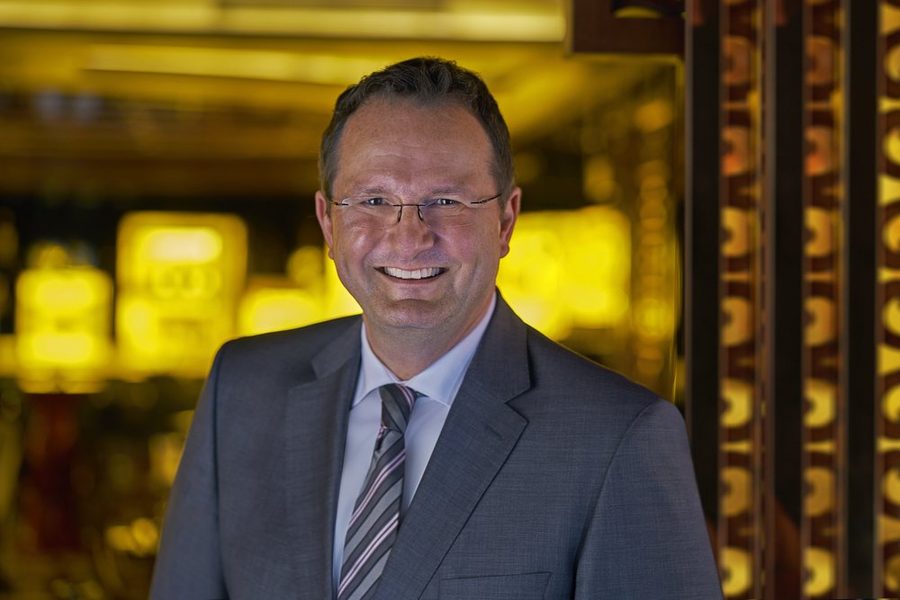
When I spoke with Kai Speth, he was general manager of The Reverie Saigon in Vietnam, after thirty six years in the industry across nine countries. He has since become Chief Operating Officer of The Bartolotta Restaurants in Milwaukee. In The Luxury of Attention he names the specific verbal move that turns training into empowerment: when a colleague brings a problem, the leader asks how they would solve it.
Speth grew up inside the business. His family ran a traditional German coffeehouse and later opened a hotel, and from an early age he worked behind the service bar. He read the hotel magazines that profiled German hoteliers abroad, people like George Schwab at The Pierre in New York and Kurt Wachtveitl at the Mandarin Oriental in Bangkok, and by ten he knew he wanted to run a famous hotel in a big city. His first job was a chef apprenticeship at the Steigenberger Hotel in Bad Kreuznach, followed by military service and a commis post at Landhaus Scherrer, a one-star Michelin restaurant in Hamburg. Kitchens at the time were brutal, with screaming and beatings treated as normal, and a later stint at an Italian restaurant in New York was no better. That experience decided him. He wanted to manage people and change how the industry treated them. By 1990 he was restaurant manager at the Polo Restaurant at the Westbury in Manhattan, where he learned that product knowledge and ambition were worth little without an understanding of how to lead people.
The idea he carries in the new book comes straight out of that conviction. A general manager is routinely expected to resolve an issue the team has raised. The real solution, he told me, is to push the challenge back. The team should be empowered to identify problems and to propose solutions, because an issue resolved that way, rather than from the top down, has a much higher chance of success. The redirect is a small move with a large cumulative effect. A team member whose first question is met with how would you solve it? will, by the third question, arrive with a proposed solution attached, and will eventually save the leader’s time for the questions that need it. Speth adds that he cannot be everywhere, and that those closest to a problem usually propose the most appropriate answer.
His second contribution is a warning I think belongs on the wall of every owner’s meeting in the coming decade.
“A true luxury offering cannot be achieved if cost cutting is the norm. Success can only come from investing in people, new product offerings and new service ideas. A shrinking budget cannot always be used as an excuse not to improve or innovate. Push to experiment.” Kai Speth, then general manager of The Reverie Saigon
The earlier profile shows what experimenting looked like under him: securing permits to land helicopters on the Reverie’s rooftop, and, at the Sofitel Legend Metropole Hanoi, instructing engineers to dig deeper during a bar renovation because he suspected a wartime bomb shelter lay beneath. They found it after two years, and the hotel now offers tours of it to guests. On technology he is clear that it no longer separates one five-star hotel from another.
“In other words, technology will not be a true differentiator moving forward. It can, however, enable a higher level of efficiency if implemented with precision.” Kai Speth, in A Wealth of Insight (2017)
Kai Speth appears in Chapter 5, Giving the Keys, where his redirect shows how a leader hands real authority to the team one question at a time, and in Chapter 14, The Future of Luxury and Craft, where his warning about cost cutting frames the chapter’s argument that the investment in people remains the one that counts. Kai’s full profile, in his own words, runs 8 pages in A Wealth of Insight: The World’s Best Luxury Hoteliers (2017).
Where Kai is now
Kai Speth is Chief Operating Officer, The Bartolotta Restaurants (Milwaukee, WI). (source, 2024)
Career
- Vice President of Hospitality, Durango Casino & Resort, Las Vegas (source, 2024)
- Signed as Cluster General Manager, WMC, Vietnam, Ho Chi Minh City (source)
- General Manager, The Reverie Saigon, Ho Chi Minh City (source, 2016)
Training
- Bachelor's degree (BA) in Hotel Management (source)
- Graduate of the International Hotel Management School in Heidelberg, Germany (source)
- Certifications from Trusthouse Forte Hotels (London), Hyatt Hotels, Accor Hotels, and Cornell University (source)
Recognition
- Named one of 10 outstanding businesspeople in Vietnam by Phong Cach Doanh Nhan magazine with the Vietnam Chamber of Commerce and Industry (2011) (source)
- MKG/HTR (France) General Manager of the Year award, luxury hotels category (2009) (source)
Checked 13 November 2026. Corrections are welcome at press@theluxuryofattention.com.
The full profile, in Kai Speth's own words
This is the complete profile of Kai Speth as published in A Wealth of Insight: The World's Best Luxury Hoteliers on Leadership, Management, and the Future of 5-Star Hospitality, reproduced word for word. Titles and positions are as they stood at the time of the interview.
Growing Up
I grew up in the hospitality business. My family ran their own traditional Germany coffeehouse and then some years later opened up a hotel. From an early age, I would help my parents by working behind the service bar. I loved the energy of a busy hotel, and the fact that guests were coming from all over. My father wanted me to take over the business when I was older, but I had other plans.
I was influenced by reading hotel magazines that profiled famous German hoteliers around the world, and it made me want to follow their path. George Schwab at The Pierre in New York City, or Kurt Wachtveitl of the Mandarin Oriental, Bangkok, were people I looked up to and wanted to emulate. I was only ten when I knew that I wanted to be a hotelier of a famous hotel. I wanted to see the world and experience the glamour of a big city.
A Tough Industry
My first job was as a chef apprentice at the Steigenberger Hotel in Bad Kreuznach, Germany. I then went on to complete my military service before rejoining the industry as a Commis de Cuisine at the Landhaus Scherrer, a one-star Michelin restaurant in Hamburg. I learned very quickly that I didn’t want to remain a chef forever, and that running a restaurant is very demanding. At the same time, back then, the treatment of young chefs in the kitchen was brutal— screaming, cursing, and beating were the norm. The pressure was through the roof, especially in a gourmet restaurant. I took a job at Palio, a now-closed Italian restaurant in New York City, and was again beaten and kicked around. I knew then that I wanted to manage people and change the industry. We needed to treat people as human beings.
Managing for Success
In the spring of 1990, I became restaurant manager at the Polo Restaurant at the Westbury New York in the heart of Manhattan. I realized then that simply having a good knowledge of product and being eager, driven, and ambitious will not alone make you successful. You need to understand how to manage people. You need to understand how to interact with people of different abilities and motivations. And you need to understand how to persuade and inspire people to act in a certain way. If you understand people, you understand leadership.
Problem + Solution
One of the most important ways to engage and empower your colleagues is to let them problem-solve. Often times you will be expected to resolve an issue that was voiced by your team, but the real solution is to push back the challenge: How would you solve it? Empower your team to not only identify challenges, but to also propose solutions. When an issue is resolved in this way—instead of from top down—there is a much higher chance of success. I also make it clear that I cannot be everywhere at all times, and that as a team we need to communicate and collaborate, resolving issues as they arise. It could be related to menu changes in the dining room, housekeeping procedures, or how the finance department could be more efficient. In many cases, those closest to the problem will also propose the most appropriate solution.
Patience is a Virtue
Throughout my career, I was always ambitious and sought the advice of my father and former general managers I worked under. Never be afraid to ask for guidance. They told me not to make hasty decisions and to patiently wait for the right role to present itself. You have to think of your career as one of longevity, so be patient until you can really identify with an opportunity to learn and grow both personally and professionally.
Dealing with Owners
One of the challenges I’ve seen over the years is the sometimes tense relationship between hotel owners and staff. I have seen numerous instances where large companies are all too eager to sacrifice members on the leadership team of a property in order to maintain a good relationship with owners.
In one such instance, an excellent manager of mine had met with the owner of a hotel in Asia. The daughter of the owner pulled me aside because she felt my manager did not bow deep enough out of respect. She told me to fire my colleague. After refusing, my superiors ultimately stepped in and transferred this manager overseas to another property. There have been similar instances with sales directors, finance directors, and executive chefs. For some time since, I decided not to work for large hotel management companies that blindly follow the orders of their owners.
Invest in the Future
Today, the finance director seems to have more authority, and this stymies innovation. A true luxury offering cannot be achieved if cost cutting is the norm. Success can only come from investing in people, new product offerings, and new service ideas. A shrinking budget cannot always be used as an excuse not to improve or innovate. Push to experiment. It is the only way to remain relevant in a very competitive industry.
The Meaning of Luxury
Luxury means different things to different people. Some will associate it with white-glove service, others with Egyptian cotton, others still with sleeping in a tent in the jungle. To each their own. The important thing is to understand that people have different expectations, needs, and motivations, and it is your job as a hotelier to understand those differences, and to both cater and personalize your service accordingly.
An Interesting Story
When I served as general manager of the Sofitel Legend Metropole Hanoi in Vietnam, the tremendous history of the hotel lent itself to an incredible story. During the renovation of the Bamboo Bar in 2011, the hotel engineering department rediscovered an underground bomb shelter that protected people from air raids during the Vietnam War. This was an accident-on-purpose. Knowing we had to renovate the bar, I instructed our engineers to dig a little deeper. We were looking for this site, and it took us two years to find it.
The area re-opened just a few years ago, serving as a memorial. We hired local tour guides, trained them in the history of the property and the bunker, and offered this tour exclusively to guests of the hotel. Indeed, the underground history of the hotel has made the property a destination unto itself. While this was a serendipitous discovery, history and heritage can tell a unique story of your property and its location. It may even change the reason people visit.
Be the First
At the Reverie Saigon, we recently received the appropriate local permits to land helicopters for commercial purposes on our rooftop—a unique offering in all of Southeast Asia, given that we are a city center high-rise. Once secured and promoted, we began to receive arrival bookings by helicopter, everyone from business executives to honeymooners. This is a very competitive industry, and in order to remain relevant, interesting, and capable of providing the very best to your clientele, you need to go the extra mile.
Doing a Lot with a Little
Once we had a guest who indicated that they had walking challenges. With this information we did our best to anticipate their needs. We assigned a room on the ground floor, we had a wheelchair and walking cane ready, a special nightlight by their bedside and bathroom, and a handlebar by their bed to make it easier for them to get in and out. One of the challenges we have as an industry is to translate guest preferences and special requests into a range of anticipatory offerings. Go above and beyond what is expected. That is how you succeed in this industry.
Means to an End
Nowadays, the most advanced technology and programmatic setup can be found in many five-star hotels around the world. In other words, technology will not be a true differentiator moving forward. It can, however, enable a higher level of efficiency if implemented with precision. For example, in our rooms we have a special control unit with two buttons—DND and Make Up Room. The latter instantly messages housekeeping staff to attend to the room. It doesn’t get any more precise.
The profile is one of the first person accounts collected in A Wealth of Insight: The World's Best Luxury Hoteliers (2017), the book that preceded The Luxury of Attention.