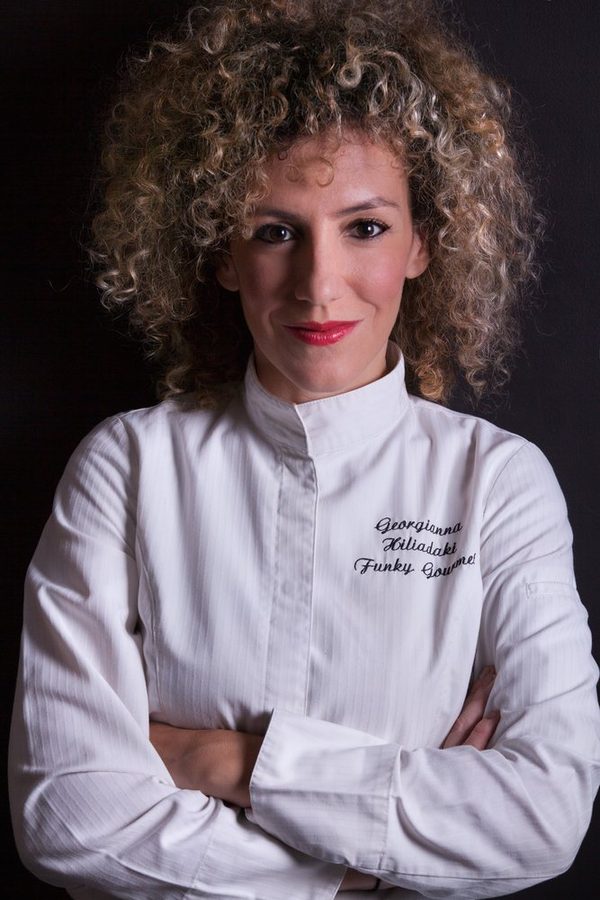
When I spoke with Georgianna Hiliadaki and Nikos Roussos, they were the pair behind Funky Gourmet in Athens, a restaurant with two Michelin stars that treated a meal as something closer to theatre. Funky Gourmet closed in 2019, and their group now runs ventures including OPSO in London. In The Luxury of Attention they carry one idea, which is that the recovery from a mistake begins inside the kitchen, in how a chef receives criticism at all.
Neither came to cooking through a family restaurant. Hiliadaki started at six, asking her mother for money to buy a children’s cookbook with recipes from around the world, and at university in the United Kingdom she organized feasts for her friends before deciding after graduation to study culinary arts in New York. Roussos was the friend who hosted food parties and fussed over the plating, and he enrolled at the Institute for Culinary Education in the same city. Both told me that their first professional kitchen was a revelation. A home cook and a professional cook are worlds apart, and they were drawn to the speed, the complexity and how demanding the work could be.
Chapter 10 is mostly about what happens between a property and a guest when something goes wrong: the correction, the apology, the moment a guest expected to become a case number and instead found a person paying attention. Hiliadaki and Roussos describe what has to happen before any of that. It is the nature of the job, they told me, to be under constant criticism, and the chef has to filter it before internalizing it. Filtering, as they describe it, is analysis. Where is the criticism coming from, is it genuine, and what, if anything, went wrong. Those questions keep a kitchen from two opposite failures, taking every complaint to heart and dismissing all of them.
“In the end, our mistakes are our best friends, since they make us better in what we do.” Georgianna Hiliadaki and Nikos Roussos, chefs of Funky Gourmet, Athens
I found the line useful because of what it removes. A kitchen that treats the mistake as a friend has taken the panic out of recovery, and a recovery without panic is the only kind a guest experiences as care rather than scramble. A team that is not afraid of its errors will look at them directly and fix them, instead of hiding them, which is where most service failures begin.
Their earlier profile shows the discipline underneath. The job, they say, requires you to be precise and organized before you can ask for those traits in others, and fairness and respect are the marks of a strong team. The dish they are best known for, a sorbet that looks white and tastes of Greek salad, came from freezing a distilled water they already had on the menu to see what would happen. Their signature plate of lamb brain took three years of experiment before it was ready. On the relation between order and invention, they borrow a line from Ferran Adrià.
“Chef Ferran Adrià once said you have to be organized in order to be creative, and this simple piece of advice has proved its wisdom many times over throughout our culinary lives.” Georgianna Hiliadaki and Nikos Roussos, in A Wealth of Insight (2019)
For a manager in any field, the two ideas belong together. Criticism is filtered rather than absorbed whole, and the mistakes that survive the filter are kept as material for the next improvement. That requires a kitchen organized well enough to find the error and calm enough to name it.
In the book, Georgianna Hiliadaki and Nikos Roussos appear in Chapter 10, The Recovery, on filtering criticism before internalizing it and on mistakes as the kitchen’s best teachers. Their full profile, in their own words, runs 4 pages in A Wealth of Insight: The World’s Best Chefs (2019).
The full profile, in their own words
This is the complete profile of Georgianna Hiliadaki and Nikos Roussos as published in A Wealth of Insight: The World's Best Chefs on Creativity, Leadership, and Perfection, reproduced word for word. Titles and positions are as they stood at the time of the interview.
How it Started
Georgianna: I first started cooking when I was six years old, and I still remember asking my mom for some money to buy my first cookbook for children—with recipes from all over the world. Ever since, I’ve loved helping her in the kitchen. While at university in the United Kingdom, I would always organize grand feasts for my friends, and it was only after graduation that I decided to pursue this passion professionally and studied culinary arts in New York.
Nikos: I would always invite my friends and family over, organizing food parties and paying special attention to plating and styling the food. I then decided to pursue my culinary passion and enrolled in the Institute for Culinary Education in New York.
The Perfect Environment
When we first entered a professional kitchen we fell in love with the whole operation. Cooking is one of those fields where a home cook and professional cook are worlds apart. We were both intrigued and excited by the craziness, complexity, fast pace, creativity, accuracy and how demanding it could be.
Lead by Example
This profession necessitates that you be extremely precise, organized and well-disciplined, in order to demand these traits in others. And when you do manage to create a strong team with similar qualities, you must always be evolving to inspire them, keep them interested, and eventually cultivate a long-lasting professional bond. Fairness and respect are hallmarks of a strong team.
Mistakes as Friends
It’s the nature of our job to always be under constant criticism, but you always have to filter that criticism before you internalize it. You need to be able to analyze where it’s coming from, whether it’s genuine or not, and you must also ask yourself what, if anything, went wrong. In the end, our mistakes are our best friends, since they make us better in what we do.
A Dual Job
Being a chef-owner can be extremely stressful at times. You must wear two hats. On one hand, you need to keep your creativity strong and alive, and on the other hand, you need to think about minimizing expenses, the cost of food and staff, and other tasks that are not very creative at all.
The Greek Salad Sorbet
Creativity is at the core of everything we do as chefs. At Funky Gourmet, we see food as a form of art, a culinary experience like going to the theater or the opera.
The Greek salad sorbet is the perfect example of our creative process. We had a distilled water of Greek salad on our menu for a few months when we asked ourselves: why don’t we freeze this distilled water to see what will happen? The outcome of this exercise was a white sorbet that tasted exactly like a Greek salad. You would see white, but you would taste tomatoes, which sparked a special game of the mind with texture. Other times we go through a lot of trial and error to reach the desired result. The most important thing to keep in mind is that we are handling food, and above all, it must be delicious. Taste cannot be sacrificed for creativity.
Mind to Plate
While some ideas are relatively easy to bring to life, others take months to mature before they make it to the menu. A classic example of this is our signature dish, the silence of the lamb. It is one of the most challenging and most delicious plates on our menu: lamb brain cooked sous-vide and finished on the pan with a lemon-oregano sauce in a lamb brain soup. The idea of using lamb brain had been on our mind for ages. We first saw the use of such an underestimated raw material in high-end cuisine at elBulli in 2005. It had a very interesting texture and taste, and we were very keen on using it but could never figure out how. Then, after three years of experimenting, the plate was perfected and integrated into our degustation menus. It is now one of our delicious signature dishes that repeat guests ask for again and again.
We often try many different things along the way because sometimes a dish can work in terms of taste, but not in terms of appearance—or vice versa. Once a new dish hits the menu, we taste it with our sommelier and discuss what would be the best wine or beverage to accompany it. The wine pairing plays a very important role in the whole culinary experience.
Words of Wisdom
The most important thing you need to know about being a professional chef is that you need to be organized, meticulous, clean, and constantly stirring waters. Chef Ferran Adrià once said you have to be organized in order to be creative, and this simple piece of advice has proved its wisdom many times over throughout our culinary lives.
The profile is one of the first person accounts collected in A Wealth of Insight: The World's Best Chefs (2019), the book that preceded The Luxury of Attention.