
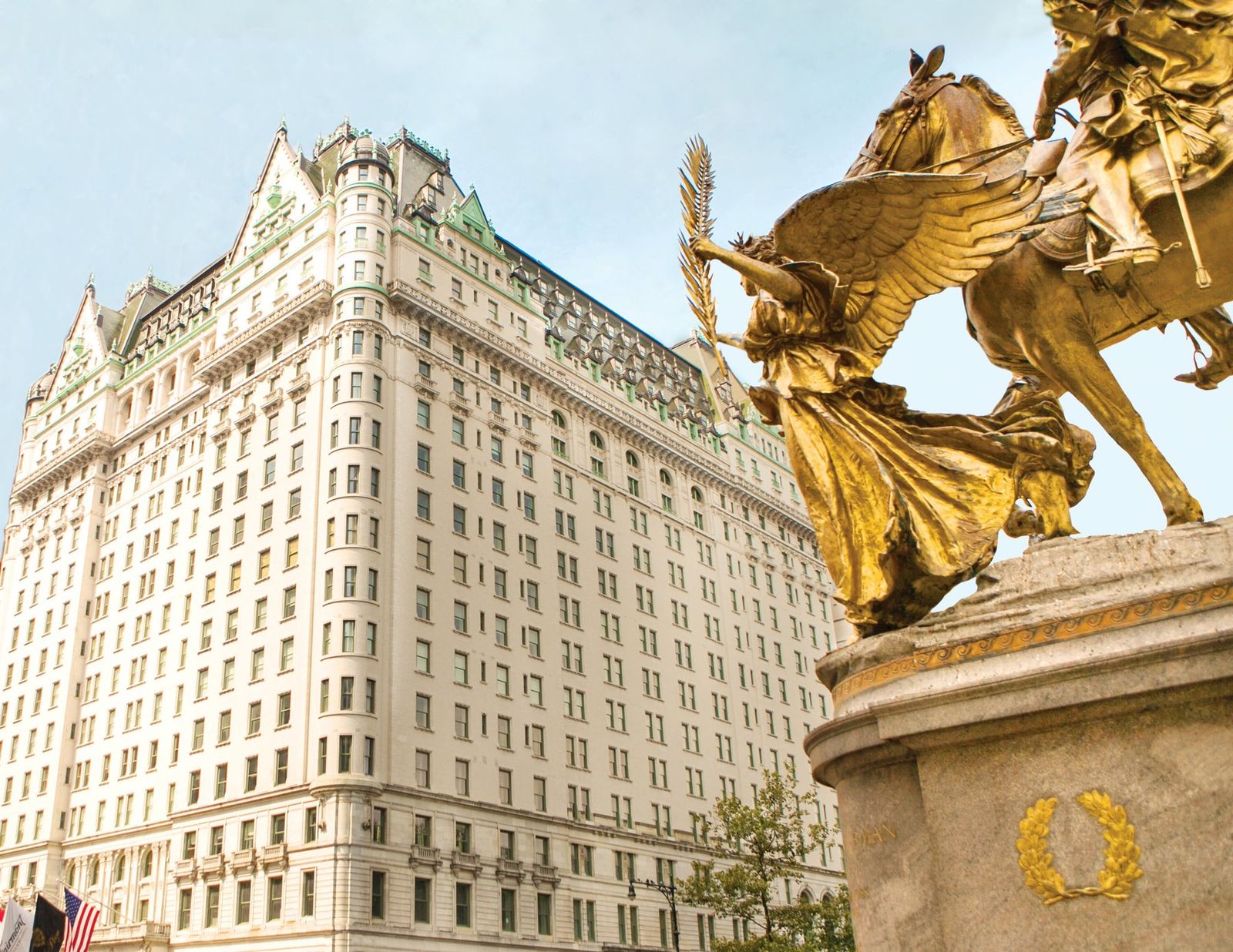
When I spoke with George Cozonis, he was general manager of The Plaza Hotel in New York, with 34 years in the industry behind him. In The Luxury of Attention he is the hotelier who grew up inside the business, and the one who teaches leading by example through a memory of the senior manager who failed to do it.
Cozonis was born in Athens. His parents ran a restaurant in Chicago, and he spent his childhood in the back of it, playing in the storeroom with the boxes after big deliveries. It did not seem to him that his parents had jobs, he told me, so much as that they were always taking care of the restaurant, its guests and its employees as though they were extended family. At seven, his father had him picking up trash in the parking lot for a dollar a cottage cheese container. From there came dishwashing, food prep, busboy and cook, and eventually his first role at The Ritz-Carlton in Phoenix, where he absorbed the idea that we were all ladies and gentlemen serving ladies and gentlemen. His career was continued rather than begun.
The parking lot stayed with him. He learned how humbling the task was and how a clean place is paramount in hospitality, and he traces to it what he still asks of his staff at The Plaza: every area must be surgically clean. Chapter 2 reads each of those early stations as the wrong section in the moment and the right one in retrospect. His earlier profile adds a later station of the same kind: laundry manager at Boston’s Parker House, where the crew taught him that no hotel runs without the people whose jobs nobody photographs.
His third appearance in the book is a negative example. As a young assistant manager of a restaurant, with half his team out and a long line of guests waiting to be seated, he asked the food and beverage director for help.
“I asked him for help and he simply walked away without a response, and made absolutely no effort to call in support. I will always remember that day. It taught me a lot about being there for your team, having integrity, and leading by example.” George Cozonis, then general manager of The Plaza Hotel, New York
He pairs that grievance with a confession from his own first leadership role, as a room service supervisor, when more than half his team called out and he tried to cover the shift by working harder instead of calling for backup. You cannot win a war without soldiers, he learned, and good intentions only go so far. A leader who can name a youthful mistake in print decades later is showing the next generation that the naming is itself part of the job.
The earlier profile is where his management method shows. He interviews every person the hotel hires, for no more than five minutes, ignoring skills and experience, which other managers have already covered, and asks only whether the candidate can make him feel good in that time, since a guest will give them even less. His test of a leader is just as plain.
“The fundamental goal of a leader should be that the unit, department, or hotel he or she leads should function equally well in the leader’s absence as when the leader is present.” George Cozonis, in A Wealth of Insight (2017)
In the book, George Cozonis appears in Chapter 1, The Calling, on a childhood spent in his family’s restaurant; in Chapter 2, The Apprenticeship, on what the parking lot taught him about cleanliness; and in Chapter 3, Leading by Example, on the director who walked away and the lesson he took from it. George’s full profile, in his own words, runs ten pages in A Wealth of Insight: The World’s Best Luxury Hoteliers (2017).
George: career record
Career
- Managing Director, The Plaza, New York (source, 2013)
- General Manager, W South Beach, Miami Beach, Florida (source, 2013)
- General Manager, The Atlantic Resort & Spa, Fort Lauderdale, Florida 2008 (source, June 2010)
- Vice President and General Manager, Sonesta Bayfront Hotel Coconut Grove, Coconut Grove, Miami 2004 (source, 2013)
Training
- Bachelor of Science in Hotel Administration, cum laude, University of New Hampshire (source)
- General Managers' Program, Cornell University (source)
Checked 13 November 2026. Corrections are welcome at press@theluxuryofattention.com.
The full profile, in George Cozonis' own words
This is the complete profile of George Cozonis as published in A Wealth of Insight: The World's Best Luxury Hoteliers on Leadership, Management, and the Future of 5-Star Hospitality, reproduced word for word. Titles and positions are as they stood at the time of the interview.
Growing Up
I was born in the heart of Athens, Greece, and spent my summers by the sea. My father was an avid outdoorsman and would take our family on frequent hiking, camping, hunting, biking, and road trips. My parents had a large circle of friends from all walks of life—academics, entrepreneurs, farmers, and artists. They were from all over the world. Being exposed to their cultures, ideas, and insights was one of the strongest influences in my life growing up. In addition, we used to travel as a family all over Greece, and my father would sometimes take me on business trips. Since I was young, I was fascinated by the hotels we visited.
Kid Gloves
In between high school and college, I spent a summer “working” at the Grande Bretagne Hotel in Athens. At nearly 200 years old, it is still one of the grandest hotels in the world. I say “working” because the owners were family friends and the staff treated me with kid gloves. This amounted to everything being explained to me, without getting my hands dirty. Looking back, the exposure to such a beautiful, well-kept and historic hotel, where the traditions of old-world European hospitality were upheld and cherished, solidified my interest in the industry.
Every last person’s work is not only useful, but essential. Imagine if there weren’t any clean pillowcases, bed sheets, or dinner napkins? The hotel would come to a complete standstill.
Not So Fast
After studying hotel management, I truly believed I would be hired as a general manager upon graduating. It was a wakeup call when, in my first job as a management trainee, I could barely keep up answering telephones at the reception desk.
The Laundry Room
I completed my management training program at Boston’s Parker House, the oldest continuously operating hotel in America. I was then offered the position of laundry manager at the same property. This was a very special unit of the hotel. Not only did it have a stable and dedicated crew, but it also employed individuals with developmental disabilities. They had been there for years and were great at what they did. This taught me that there is a place for everyone in our industry and that working in a community such as a hotel can bring precious and critical value to a person’s life—no matter the role.
Working on the laundry team also made me realize that it isn’t the relatively few glamorous jobs that make a hotel what it is. Every person’s work is not only useful, but essential. Imagine if there weren’t clean pillowcases, bed sheets, or dinner napkins. The hotel would come to a complete standstill.
A Culture of Service
A shared vision, common goals, and a commitment to serve are at the heart of team culture. In this industry, every colleague must have, in his or her heart, a spirit of service. In practice, this means that the entire team must consistently adhere to a set of behaviors, standards, and good habits that serve the guests, the employees, and therefore the organization.
Luxury Evolved
Not long ago, luxury in the context of hotels was mainly about feather-top mattresses, silver teapots, and champagne. Today, those are not the only things that count. Each customer has his or her own set of customer aspirations, and they have evolved over time. Therefore, the ideal relationship between guests and staff is one in which staff are trained to seek out, learn, and understand what is important for every guest. They must then have the skill and authority to deliver. I believe the only thing that can make a customer-staff relationship even more effective is when a customer actively invests time and energy into creating a positive rapport with staff. I am sure that many will regard this as a heretical statement, but I truly believe in it.
Present or not
The fundamental goal of a leader should be that the unit, department, or hotel he or she leads should function equally well in the leader’s absence as when the leader is present. In other words, a leader’s job is to build a great team, empower it, trust it, and support it to deliver. A leader should not micromanage day-to-day operations.
Positive Emotional Experiences
I interview every person we hire. I don’t focus on a person’s skills or experience. Other managers will have already conducted thorough interviews with the applicant about experience and credentials. My interviews only last three-to-five minutes, during which I focus on how the candidate can make others feel. Even though we are in the business of creating positive emotional experiences, most interactions between staff and guests are brief. It can take less than three minutes to check into a hotel. It takes sixty seconds to place a breakfast order and minutes to deliver it. Hotel employees don’t have the luxury of a lot of time in which they can make guests feel good. They must be able to do so in the span of a few minutes or even a few seconds. If the candidate cannot make me feel good in less than five minutes, chances are that he or she will not be able to accomplish that with a guest either.
Formality Still Matters
There was a time when one did not need to be taught, at least in the workplace, that one does not chew gum when working, or that silverware placed in a certain way on one’s plate signaled that the plate could be cleared, or that responding to “thank you” with “no problem” or “sure” just isn’t done. Today, the bar for formality is much lower, but it still matters in the luxury space.
A Mismatch of Investment
It has always struck me as odd that the hotel investment community will think nothing of spending several hundred thousand dollars on a chandelier or millions decorating a lobby—and only pennies, by comparison, on training staff. People are our one irreplaceable resource, and the need for training is more intense than ever. Some enlightened owners understand this, but overall the industry is strikingly behind in keeping up with this need. Every luxury hotel should have a training department, complete with classrooms, trainers, educational tools, and a commensurate payroll spend. I think that we have a long way to go as an industry in this respect.
Feel Good Luxury
Luxury is not only about crystal chandeliers, champagne, and caviar. It is about making guests feel good. A guest who eats at McDonalds and is made to feel good is just as appreciative of the experience as a guest at The Plaza. A boutique hotel is just as much of a business as an ultra-luxury property. If you’re looking to join the industry, it’s important to find the market segment that is best suited to your personality and style.
Be Cool, Be Detailed
There is one common denominator that all luxury hotels share—drama, and lots of it. Temperament and ability to manage difficult situations are incredibly important to success. At the same time, so is an infinite attention to detail. This is something some people enjoy and others do not. Be honest with yourself about your skillsets.
A Vision for Your Career
Do not focus on your “next job.” Instead, focus on a vision of where you would like to be eventually. Once you have this in mind, evaluate every career opportunity that comes to you by two criteria: Will you learn from it? Will it enable you to make a contribution that your employer will value? Always progress professionally with a big-picture plan in mind.
Treat Every Guest Equally
A high net-worth customer who spends vast amounts of money in your hotel is very important. You must pay great attention to this kind of guest. Yet, never at the expense of the customer who spends a few hundred dollars for one night in the smallest room available. That customer may have been saving up in order to celebrate a wedding anniversary in a hotel as luxurious as the one where you happen to work. Disappointing them in any way is far more serious, in my view, than disappointing the guest who spends almost every night of the year in luxury hotels.
As a Guest, Feel at Home
Hotels always aspire to be homes away from home. In order for that to be realized, technology must be comparable to what a guest has at home. The first thing that many guests do when they check into a hotel is connect their devices to the Wi-Fi network. If cell phone reception in a hotel is weak, it can ruin a guest’s stay. We have invested heavily in Wi-Fi and have also installed cell phone signal repeaters for complete coverage. We offer additional features, such as the ability for guests to connect their devices, wirelessly, to their guestroom televisions so that they may play their own content. This is what they do at home. They must be able to do it here if they are to feel at home. Moreover, since many people find it more efficient to stay connected via text messaging, we now offer guests the option of communicating with us in that way, too.
The profile is one of the first person accounts collected in A Wealth of Insight: The World's Best Luxury Hoteliers (2017), the book that preceded The Luxury of Attention.